
- Home Page
- Accepted
Paintings & Copies - Doubtful
Attributions - Doubtful Textual References
- Alternative
Titles - Collectors &
Museums - Bibliography
- Search Abecedario
- Watteau &
His Circle
Galants propos
Entered January 2023

Whereabouts unknown
Materials unknown
Measurements unknown
RELATED PRINTS

Louis Crépy after Watteau, Galants propos, c. 1731, engraving.
This engraving after Watteau’s composition is special because it predates Jean de Jullienne’s full-fledged Oeuvre gravé. The inscriptions at the bottom recognize that it is after a Watteau painting (“Wateau pinx.”) and that it was engraved by Louis Crépy (Crepy filius Sculp.), but it does not include a title for the painting as would become customary in the Jullienne corpus. At the bottom, at the center, the text reads: “Chez Gersaint Md A Paris pont nôtre Dame.” Apparently the print was issued in a small run since few exemplars have come down to us. When Gersaint’s first wife died in 1725, her estate included the engraving plate and 50 proofs.
SELECT BIBLIOGRAPHY
Goncourt, Catalogue raisonné (1875), 368.
Dacier, Vuaflart, and Hérold, Jean de Jullienne et les graveurs (1921-29), II: 79, III: 21, 124, 138, cat. 293 bis.
Réau, “Watteau” (1928), cat. 131.
Roux, Fonds français (1930-77), 5: 385-86, cat. 2.
Adhémar, Watteau (1950), cat. 199.
Macchia and Montagni, L’opera completa di Watteau (1968), under cat. 180.
Rosenberg and Prat, Watteau, Catalogue raisonné des dessins (1996), cat. G94.
Glorieux, À l'Enseigne de Gersaint (2002), 182, 185, 190.
RELATED DRAWINGS
As discussed below, Galants propos was based on figures that Watteau had already painted in Fêtes vénitiennes. The question that remains is whether Watteau created this new work by copying the existing painting or did he revert to his original drawings. The former seems more likely since he was preserving the unity of the ensemble, something that would not have been possible from his original drawings from the model.
REMARKS
A most notable aspect of Galants propos is that this Watteau composition has not been mentioned, much less discussed, by most Watteau scholars. Not only was it bypassed by early scholars such as Hédouin, Zimmerman, Mantz, and Fourcaud, but also by more recent critics such as Mathey, Brookner, Ferré, Posner, Roland Michel, and Temperini. Even though the seated woman with a fan in her lap, a prominent figure in this composition, was based on a now-lost drawing recorded in the Figures de différents caractères, this is not cited by Rosenberg and Prat. Indeed, were it not for the engraving after Galants propos by Louis Crépy, we might not even be aware of its existence. By itself, the engraving is rare and Goncourt only became aware of it belatedly, adding it to his Additions section. No name was attached to the composition when it was engraved, and Goncourt did not apply one either. Thus, if it appeared in eighteenth- or nineteenth-century sales, we might be unable to recognize it. The title Galant propos (Gallant Talk or Conversation) was not introduced until the 1920s, when it was used by Dacier, Vuaflart, and Hérold, as well as by Réau.
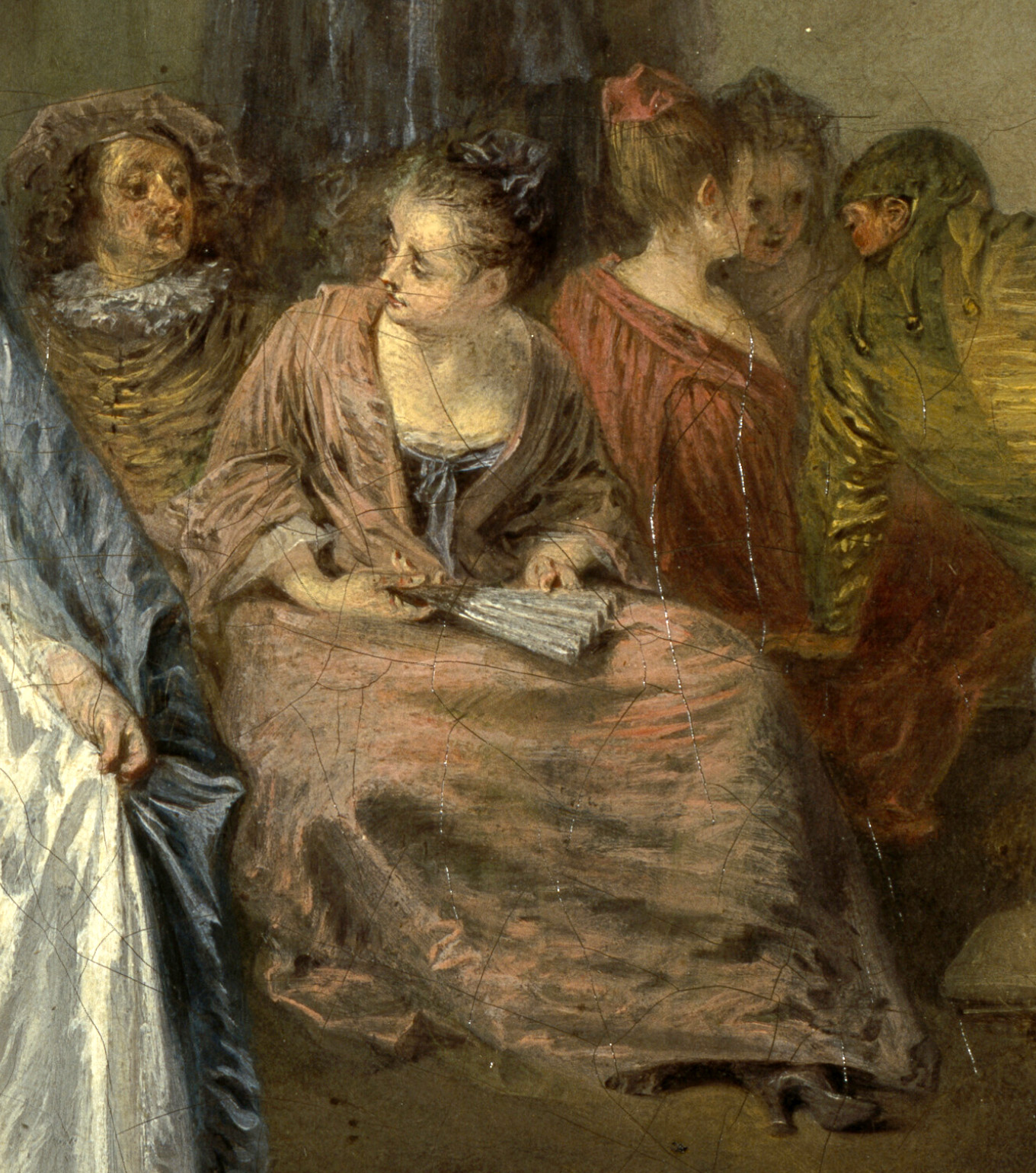
Watteau, Fêtes vénitiennes (detail), Edinburg, National Galleries of Scotland.
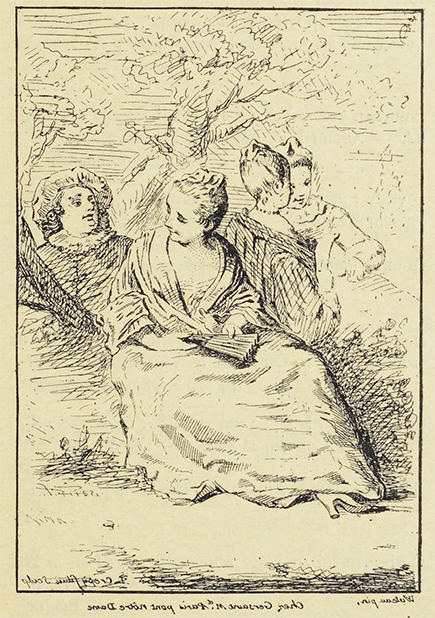
Louis Crépy after Watteau, Galants propos, engraving (here reversed).
Without the painting itself and without supporting documentation, it is difficult to reach firm conclusions about Galants propos but some surmises are possible. Crépy’s engraving specifies “Wateau pin.,” that is, it copies a painted composition by Watteau. This is significant and rules out the possibility that the engraved composition was based on a drawing. Almost all scholars who have considered Galants propos have labeled it an “étude” or “esquisse,” with the implicit suggestion that it represents a preliminary stage for a more finished painting. Yet except for Dacier and Vuaflart, scholars have not proposed what painting the study might have been intended for. Dacier and Vuaflart rightly recognized that Crépy’s scene corresponds to a group at the right side of Fêtes vénitiennes. A major difference between the two is that in Crépy’s engraving the figures are set within a clump of trees and hastily indicated shrubbery, none of which is present in the Edinburg painting.
The inevitable next question is whether Galants propos represents a preliminary stage of planning for the larger painting or was it an independent work conceived afterward, a partial echo of Watteau’s more ambitious composition. There is no proof that he ever painted preparatory studies. Whereas there are many oil sketches falsely ascribed to Watteau, none of them are evidence that Watteau painted preliminary oil studies. Quite the opposite!
Similar issues surround Watteau’s Bon voyage. This painting, also known only through an engraving, appears to be a repetition by Watteau of figures from his larger, more ambitious work, Le Pèlerinage à l’Ile de Cythère; but other scholars have proposed that it is a preparatory study. Although Galants propos is more fragmentary than Bon voyage, it too appears to be an echo of a previous painting.
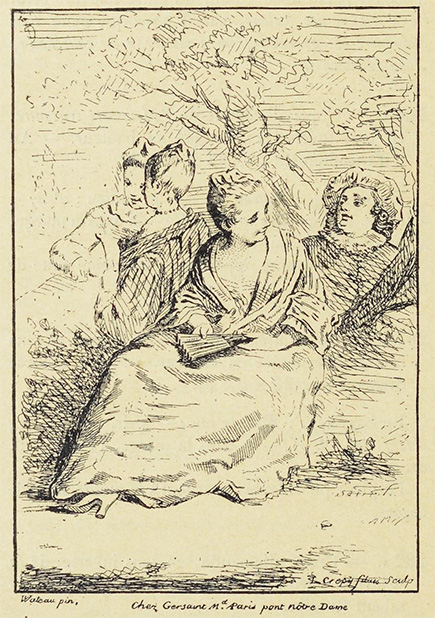
Louis Crépy after Watteau, Galants propos, engraving.
Watteau, Fêtes vénitiennes (detail), Edinburg, National Galleries of Scotland (here reversed).
As mentioned above, this engraving by Louis Crépy showing two couples engaged in conversation corresponds to figures situated right of center, slightly back, in Fêtes vénitiennes. The engraving is special because it predates Jean de Jullienne’s full-fledged Oeuvre gravé. The inscriptions at the bottom recognize that it copies a Watteau painting (“Wateau pinx.”) and that it was engraved by Crépy (“Crepy filius Sculp.”). At bottom center, the text reads: “Chez Gersaint Md A Paris pont nôtre Dame.” Exceptionally, it does not include a title for the painting, something that would become customary in the Jullienne corpus.
It is thought that the print was issued early, c. 1731, before Jullienne embarked on his program to create his extensive corpus of engravings after Watteau’s paintings. Apparently it was issued in a small run since few exemplars have come down to us. When Gersaint’s first wife died in 1725, her estate included the engraving plate and 50 proofs.
The print has not been mentioned, much less discussed, by most Watteau scholars. Unknown to Hédouin and discovered only at the last minute by Goncourt, it subsequently was bypassed by early scholars such as Zimmerman, Mantz, and Fourcaud. Likewise, it is not cited by recent critics such as Mathey, Brookner, Ferré, Posner, Roland Michel, Rosenber and Prat, Temperini, and Glorieux. Goncourt only became aware of this rare print belatedly, including it in his Additions section, where it is easily overlooked. Adding to the ignomy, no name was attached to the composition when the print was executed, and Goncourt did not apply one. The title Galant propos (Gallant Talk or Conversation) was not introduced until the 1920s, when it was employed by Dacier, Vuaflart, and Hérold, as well as by Réau. Some scholars such as Adhémar use the plural form: Galants popos.
The major question surrounding Galant propos is the identity of the painting it records. Some critics, such as Adhémar, have called it a sketch, but a sketch for what? It is well established that Watteau did not execute painted sketches in preparation for his pictures. Others have thought that Galants propos was a small repetition executed after the artist completed this more complex Fêtes venitiennes. This remains a possibility since, he did this when he modeled his Bon voyage after the Louvre Pèlerinage à l’ile de Cythère. However, no such repetition is recorded in eighteenth- and nineteenth-century sales although, of course, we are handicapped by the lack of a name for this supposed painting.
There is another possible explanation for Crépy’s engraving, one that might seem radical but is compelling. It may be that the engraving was based directly on just the small section of Watteau’s painting with these four figures. Whereas the Jullienne corpus invariably recorded the whole of each Watteau composition, that practice may not yet have been instituted when Crépy made his engraving. Several elements in the engraving point to its direct link with the Edinburgh painting. When executing Galant propos, Crépy masked some of the problems he faced in transcribing Watteau’s painting. For example, the half figure of the man has a tree branch emerging awkwardly from his midsection. Looking back at the painting, we discover that Crépy has taken his lead from the diagonal of the dancer’s arm. Also, the right side of the woman’s skirt, with its strange, uneven ripple, is the vestigial remainder of the dancer’s skirt. A telling giveaway is the man at the left in Crépy’s engraving. This generic figure, whose facial features are not in accord with Watteau’s distinctive style, appears in Fêtes venitiennes but nor distinctly. He is more Crépy’s invention to replace an insufficient model. The liberties that Crépy took are surprising. Shortly thereafter, as Jullienne’s team of engravers began to work in earnest on the Oeuvre gravé, they remained more faithful to their models.