
- Home Page
- Accepted
Paintings & Copies - Doubtful
Attributions - Doubtful Textual References
- Alternative
Titles - Collectors &
Museums - Bibliography
- Search Abecedario
- Watteau &
His Circle
La Musette
Entered February 2026; revised September 2026
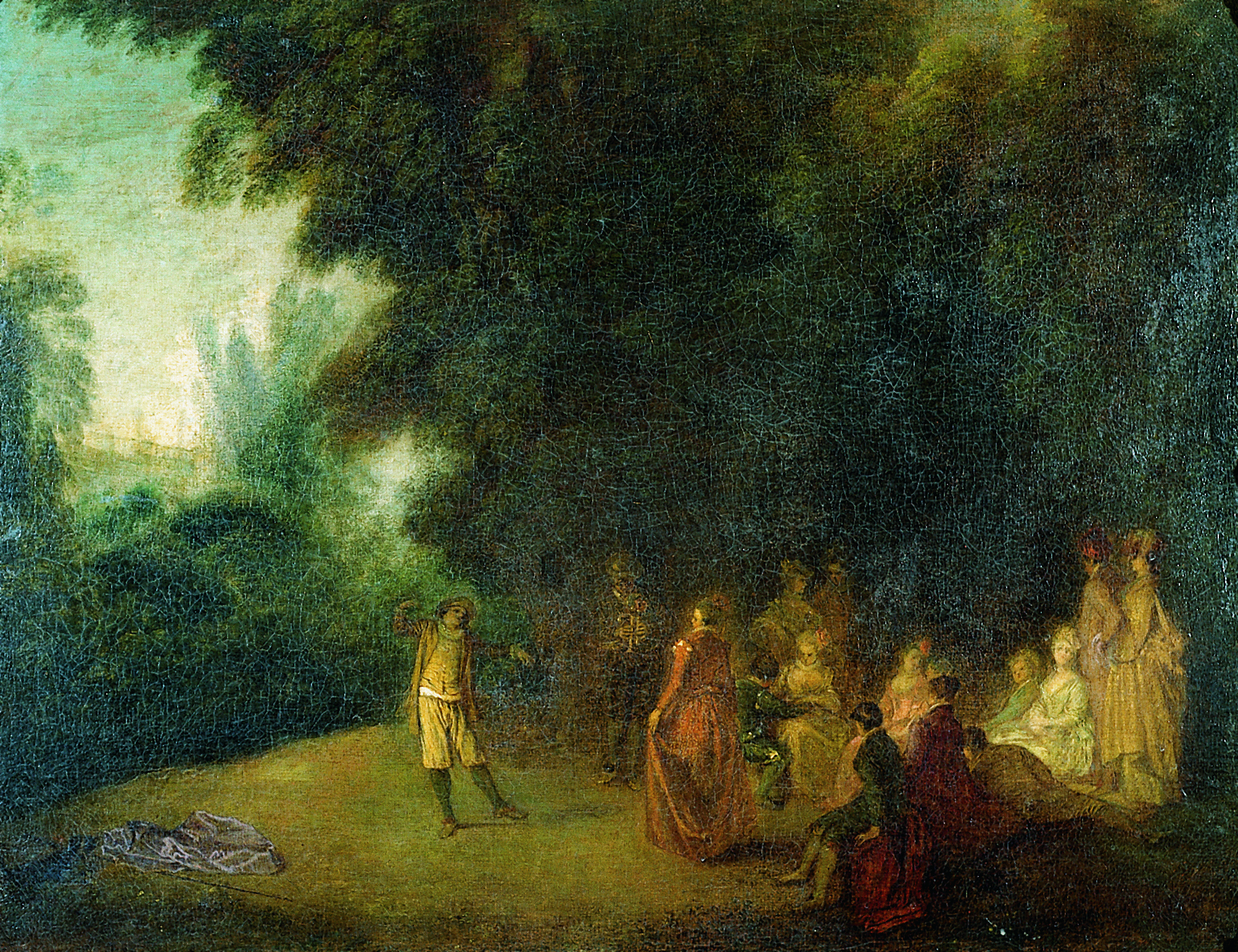
China, private collection
Oil on canvas
43.4 × 55.1 cm
ALTERNATIVE TITLES
The Bagpipe
Coppia danzante, zampognaro e tredici astanti
La cornamusa
Tanz nach dem Dudelsack
RELATED PRINTS
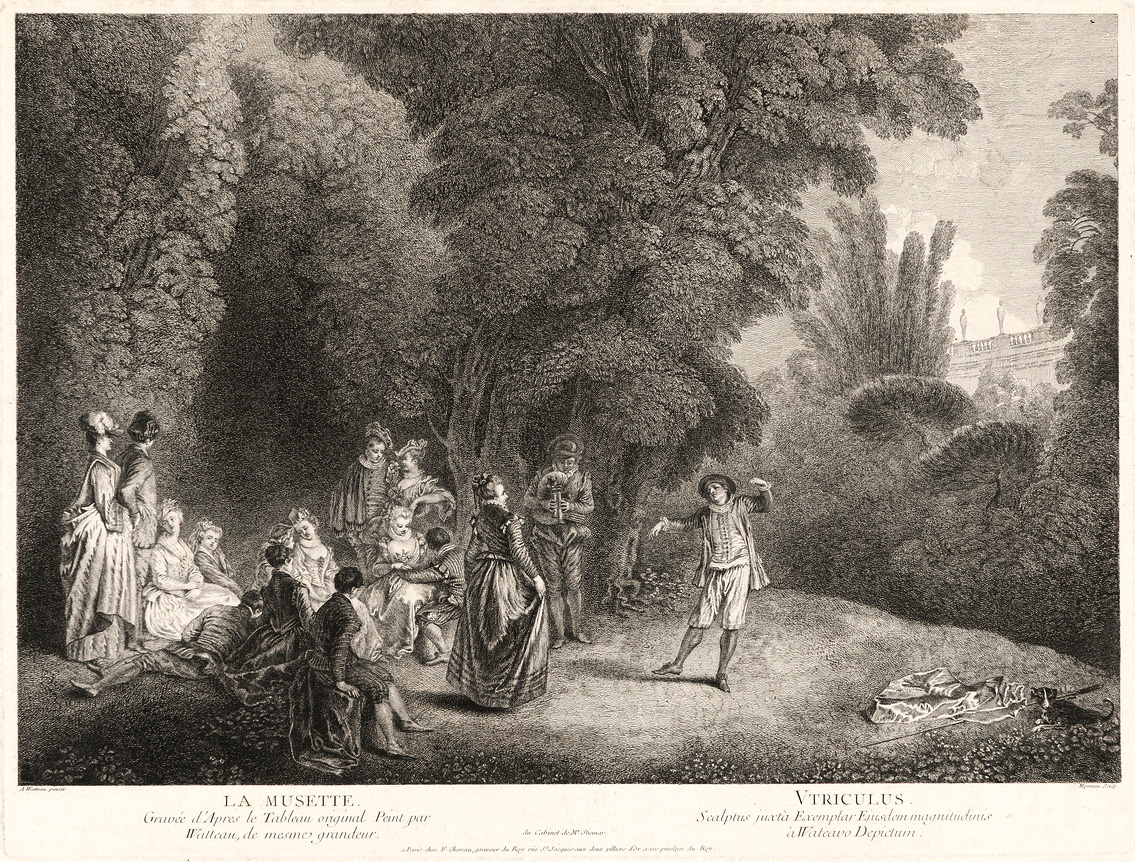
Jean Moyreau after Watteau, La Musette, engraving.
La Musette was engraved in reverse for Jean de Jullienne’s Oeuvre gravé by Jean Moyreau. It was not announced for sale in the Mercure de France so we cannot date the engraving. Although the print states that it was engraved the same size as the original canvas, there are discrepancies between the sizes of the print and the painting now in China, especially in regard to the height of the composition.
PROVENANCE
Paris, collection of François Albert Sitémart (1680-1740; painter). His probate inventory, Versailles, December 2, 1740: “Item un tableau peint sur toille par Vato representant un paysage et une danse villageoise dans sa bordure en bois doré prisé soixante douze livres” (Saint-Quentin-en-Yvelines, Archives départementales des Yvelines, 3E46 32).
Paris, collection of Symphorien-Casimir-joseph Boittelle (1813-1897, politician); his sale, Paris, Pillet, January 10, 1867, lot 199: “WATTEAU (ANTOINE). . . . La Musette. Gravé. Toile. Haut. 42 cent., larg.: 53 cent.” Bought for 1,620 francs by Nariskin (Archives de Paris)
Paris, collection of B. Narishckine; his sale, May 4, 1868, lot 67: “Watteau. La Musette. (Vente Boitelle). H. 42 c. L. 53 c.” Bought for 700 francs by Henri Haro.
London, collection of R. P. Attenborough of Shaftesbury Avenue. His sale and others, London, Christie’s, July 1, 1899, lot 104: “A. WATTEAU. LA MUSETTE: A scene in the gardens of a chateau, with a lady and gentleman dancing in the foreground; a group of thirteen ladies and gentlemen on the left, seated under the shade of overhanging trees. And the Engraving, by Moyreau. 16 in. by 21 1/2 in. Described in De Goncourt's Book, p. 184.” Although an annotated copy of the auction catalogue in the Rijksbureau voor Kunsthistorische Documentatie lists the lot as selling for £1,434 to “Lord G,” Christie’s official record indicates that it was bought in.
Paris, collection of Jean or Juan Lassalle (d. 1901); his sale, Paris, Lair-Dubreuil, December 16, 1901, lot 24: “WATTEAU (Antoine). La Musette. A l’ombre de grands arbres, sur un tertre, une nombreuse compagnie composée de jeunes cavaliers et de dames, causent entre eux ou regardent bas on voit des bouquets d’arbres et dans le fond un palais se silhouette sur un ciel légèrement nuageux. Gravé par Moyreau. Toile. - Haut.: 44 cent.; Larg. : 55 cent.” Bought for 17,500 francs by Eugène-Alfred Kraemer.
Paris, collection of Eugène-Alfred Kraemer (1852-1912, art dealer). His sale, Paris, Georges Petit, April 28-29, 1913, lot 69: “WATTEAU (ANTOINE). La Musette. Dans un parc, au son de la musette, dont joue un musicien debout au second plan et accoudé contre un tronc d'arbre, un couple danse au centre. Le jeune homme, en habit de couleur jaune clair et veste marron ouverte sur la poitrine, a les deux bras levés et esquisse un pas; sa compagne est vis-à-vis de lui, elle tient de ses deux mains les plis de sa jupe rouge.
A droite, de nombreux personnages sont réunis devant un bouquet d'arbres, un rayon de soleil éclaire un groupe au milieu duquel on distingue une jeune femme en bleu pâle, assise à terre, la tête tournée vers le spectateur. Les uns se reposent, les autres se livrent aux entretiens galants; un jeune mezzetin a pris par la taille une jeune femme en robe rose.
Au second plan, vers le fond, un nouveau couple vient de sortir du bois et s'approche de l'élégante compagnie.
A gauche, sur le sol, un chien est couché près d'un manteau et d'une houlette. Une allée s'ouvre plus loin, et au-dessus des arbres on aperçoit, dans le fond, un palais à l'italienne couronné d'une balustrade et de statues de pierre.
Toile. Haut., 44 cent.; larg., 55 cent. Cadre en bois sculpté. Gravé par Moyreau. Collection Lassalle (vente des 16/19 décembre 1901, n° 24).
A figuré à l'exposition des Peintres français et anglais du XVIIIe siècle, à Londres, à Guild Hall, en 1902.
Reproduit dans les Classiques de l'Art: Vatteau. Hachette, éd.; p. 17.” Bought for 42,600 francs by Édouard Jonas.Paris and New York, with Edouard Jonas (1883-1961; art dealer)
South America, private collection (from 1913, and by descent until 1997).Sale, New York, Christie’s, October 21, 1997, lot 56: “Jean-Antoine Watteau . . . A Fête Champêtre: 'La Musette' / oil on canvas / 17 3/8 x 22 5/8in. (44 x 55cm.)
PROVENANCE / François Stiémart (1680-1740), 'a painter of the Academié Royale' according to Mariette. / Boitelle, Paris; his sale, Paris, Jan. 10-1, 1867, lot 199 (1,620 francs). / Baron de Reuter, Paris; his sale, Christie's, London, July 1, 1899, lot 104 (£1,434 to 'Lord G...'). / J. Lassalle; his sale, Hôtel Drouot, Paris, /Dec. 16-9, 1901 (=1st day), lot 24. / Eugène Kraemer; his sale, Galerie Georges Petit, Paris, April 28-9, 1913 (=1st day), lot 69 (42,600 francs to Jonas). Private collection, South America (from 1913), and by descent to the present owners.
LITERATURE E. and J. de Goncourt, L'Art du Dix-Huitième Siècle, 1881, p. 149. E.H. Zimmermann, Classiques de l'Art: Watteau, 1912, p. 17, illustrated. E. Dacier, J. Hérold and A. Vuaflart, Jean de Jullienne et les Graveurs de Watteau au XVIIIe Siècle, I, 1921-9, p. 181; II, pp. 51, 65, 94, 96, 122, 130 and 162; III, no. 262. / L. Réau, Watteau, in L. Dimier, Peintres Français du XVIIIe Siècle, 1928, I, no. 78. / H. Adhémar, Watteau, sa vie, son oeuvre, 1950, p. 39, no. 133 as datable to 1716 / J. Mathey, Antoine Watteau. Peintures Réapparues, 1959, p. 66, as datable to circa 1707-8. / J. Ferré, Watteau, 1972, I, pp. 93, 189, 192, 212, 277 and under the years 1867 and 1899; II, p. 510; III, p. 985, no. B44.E. / Camesasca and P. Rosenberg, Tout l'Oeuvre Peint de Watteau, 1982, no. 93 as datable c.1712. / M. Roland Michel, Tout Watteau, 1982, no. 131 as dated 'c.1714?' . / / D. Posner, Antoine Watteau, 1984, p. 279, note 24./ M. Morgan Grasselli and P. Rosenberg, Watteau 1684-1721, in the catalogue of the exhibition, Washington, National Gallery of Art, Paris, Galeries Nationales du Grand Palais, and Berlin, Schloss Charlottenburg, 1984-5, p. 79, under no. D18; p. 268, under no. P11; and p. 300, under no. P24 ('The Musette, the original of which cannot be traced after the Kraemer sale of 28-9 April 1913...'). / M. Morgan Grasselli, The Drawings of Antoine Watteau: Stylistic Development and Problems of Chronology, unpublished doctoral dissertation, Harvard University, 1987, I, pp. 173-5, 182, 455-6; II, nos. 64 and 91. ; P. Rosenberg and L.-A. Prat, Antoine Watteau 1684-1721. Catalogue Raisonné des Dessins, 1996, I, pp. 166-7, under no. 104; pp. 218-9, under no. 137; pp. 292-3, under no. 185.
EXHIBITED / London, Art Gallery of the Corporation of London, Exhibition of a Selection of Works by French and English Painters of the Eighteenth Century, no. 127 (lent by Kraemer).
London, art market, c. 2016.
China, Private collection.
SELECT BIBLIOGRAPHY
Mariette, Notes manuscrites, 194.
Hédouin, "Watteau" (1845), cat. 88.
Hédouin, Mosaïque (1856), cat. 89.
Goncourt, L'Art au XVIIIème siècle (1860), 57.
Goncourt, Catalogue raisonné (1875), cat. 149.
Zimmermann, Watteau (1912), pl. 17.
Dacier, Vuaflart, and Hérold, Jean de Jullienne et les graveurs (1921-29), 1: 181, 2: 51, 65, 94, 96, 122, 130, 162; 3: cat. 262.
Réau, "Watteau" (1928), cat. 78.
Adhémar, Watteau (1950), cat. 133.
Parker and Mathey, Watteau, son oeuvre dessiné (1957), cat. 5, 29, 40.
Macchia and Montagni, L'opera completa di Watteau (1968), cat. 93.
Ferré, Watteau (1972), cat. B44.
Roland Michel, Watteau (1981), cat. 131.
Washington, Paris, Berlin, Watteau 1684-1721 (1984), under cat. D18, under cat. P11 and P24.
Posner, Watteau (1984), 22, 279, n. 24.
Rosenberg and Prat, Watteau, Catalogue raisonné des dessins (1996), cat. 104, 137, 185.
Michel, Le «célèbre Watteau» (2008), 155, note 107.
Glorieux, “’Stiémart, peintre et bon copiste’” (2009), 177, note 57.
RELATED DRAWINGS
Watteau, La Musette (detail).
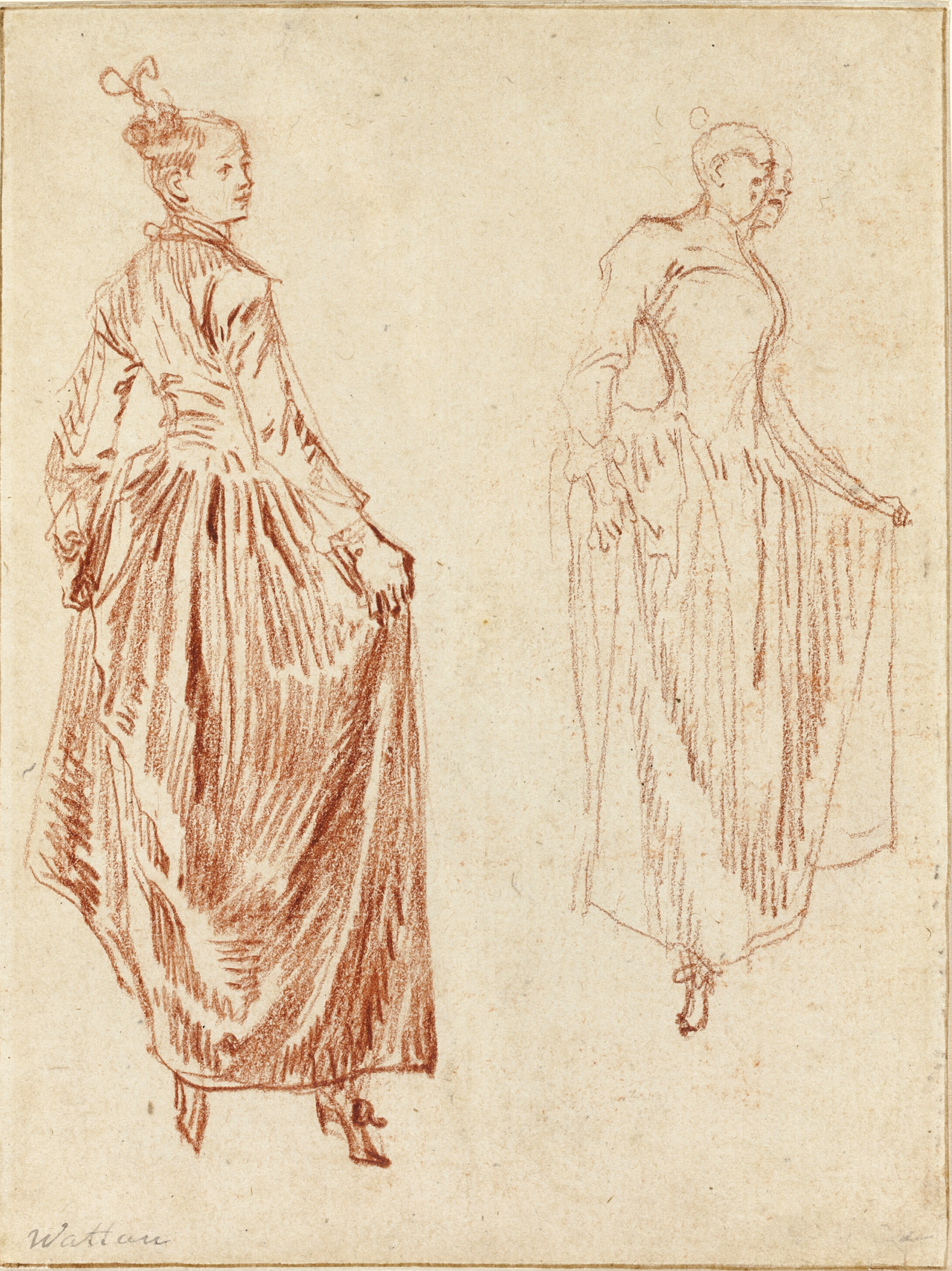
Watteau, Two Studies of a Woman Dancing, red chalk, 17.6 x 13.3 cm. Chicago, the Art Institute.
Of the two central figures in La Musette—the man and woman dancing—the woman can be traced to a Watteau sheet of studies in Chicago (Rosenberg Prat 185). The drawing contains two views of the same model but seen in reverse. There may well have been a third study on this sheet which, unfortunately, was trimmed down in the past.
Quite unexpected, while many of the remaining characters ca be traced to the artist’s drawings, more than ten of them repeat figures in La Mariée de village (or vice versa). It is not just a matter of individual figures but also their organization as a unit. Thus, the question arises as to whether these figures in La Musette were derived from the artist’s original drawings or, more likely, from La Mariée de village. The way that they are similarly arranged in both paintings rules out the possibility that they were created independently of each other. Several of the same figures, in smaller units, appear in a third Watteau painting, Le Bal champêtre, but that is another matter.
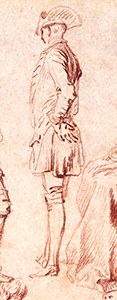
Watteau, Seven Studies of Women and Men (detail), red chalk, Dijon, Musée des beaux-arts.
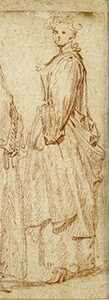
Watteau, Three Studies of Women (detail), red chalk, Paris, Musée Carnavalet.
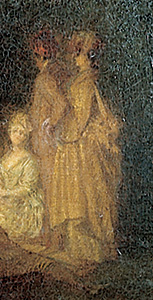
Watteau, La Musette (detail).
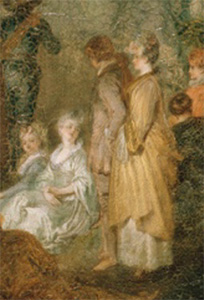
Watteau, La Mariée de village, Charlottenburg, Staatliche Schlösser und Gärten.
A good example of the problem before us involves the couple at the far right of La Musette. The identical couple also appears at the right side of La Mariée de village. This group can be traced to two Watteau drawings: the man from a sheet of studies now in the Dijon Musée des beaux-arts (Rosenberg and Prat 107) and the woman from a study in the Musée Carnavalet (Rosenberg and Prat 185). That Watteau was able to fuse them into a believable unit and transfer them to his painting was his special talent. After resolving this couple on the first canvas, he then copied it on to the second. Moreover, in both the woman wears a remarkable yellow gown, information not conveyed in his drawings for his second rendering. This makes it even less likely that he would have turned back to his original drawings. But which painting came first—La Musette or La Mariée de village? As discussed below, critics are divided regarding the chronology of the two pictures.
REMARKS
The first owner of La Musette was François Albert Stiémart, a painter who specialized in copies and restoration, and who about 1730 rose to become garde des tableaux du roi at Versailles. He was born only four years before Watteau in Douai, in northern France. He arrived in Paris at the same moment as Watteau, circa 1702-03. There may have been links between the two painters. Stiémart’s probate inventory lists not only La Musette but also a copy after Watteau described as a “paysage en longueur.” That painting cannot be identified with a specific work; and the term “paysage” may refer to a fête galante, in accord with that era’s usage.
The title La Musette describes the instrument played by the musician and placed between the two dancers. Essentially, the musette is a type of bagpipe). There were traditional and courtly variants. The musician here plays a hybrid version, blowing air in the oboe directly—an action not possible with the musette de cour.
As generally occurs, Watteau scholars have suggested a variety of dates for La Musette. Mathey proposed 1707, but most scholars have prefered a later date. Relying on the drawings, Grasselli favored 1712, and Montagni and Macchia also suggested 1712. Roland Michel listed the painting as 1714, while Adhémar preferred 1716. The diversity of opinion.is noticeable.
Given the closeness in appearance between La Musette and La Mariée de village, one might expect to find that the the chronolgies proposed for the two would be similar. Yet this does not prove to be the case. For example, Mathey, who generally dated individual Watteau paintings earlier than most scholars, dated La Musette cicrca 1707and placed La Mariée de village circa 1710—still a relative early date when compared with the dates assigned by most others scholars. More divergent, Adhémar placed La Mariée de village c. 1710-11 and dated La Musette c, 1716. In short, there is little agreement betweens scholars, not even within their own schemes. Although it is generally posited that La Mariée de village had chronolgical proriority, not even this basic assumption is agreed to by all scholars.
For copies of La Musette, CLICK HERE