
- Home Page
- Accepted
Paintings & Copies - Doubtful
Attributions - Doubtful Textual References
- Alternative
Titles - Collectors &
Museums - Bibliography
- Search Abecedario
- Watteau &
His Circle
Le Passe-temps
Entered May 2026

Presumed lost
Materials unknown
36.8 x 43.2 cm
ALTERNATIVE TITLES
Fête champêtre
Le Printemps
Riune all’aperto
RELATED PRINTS
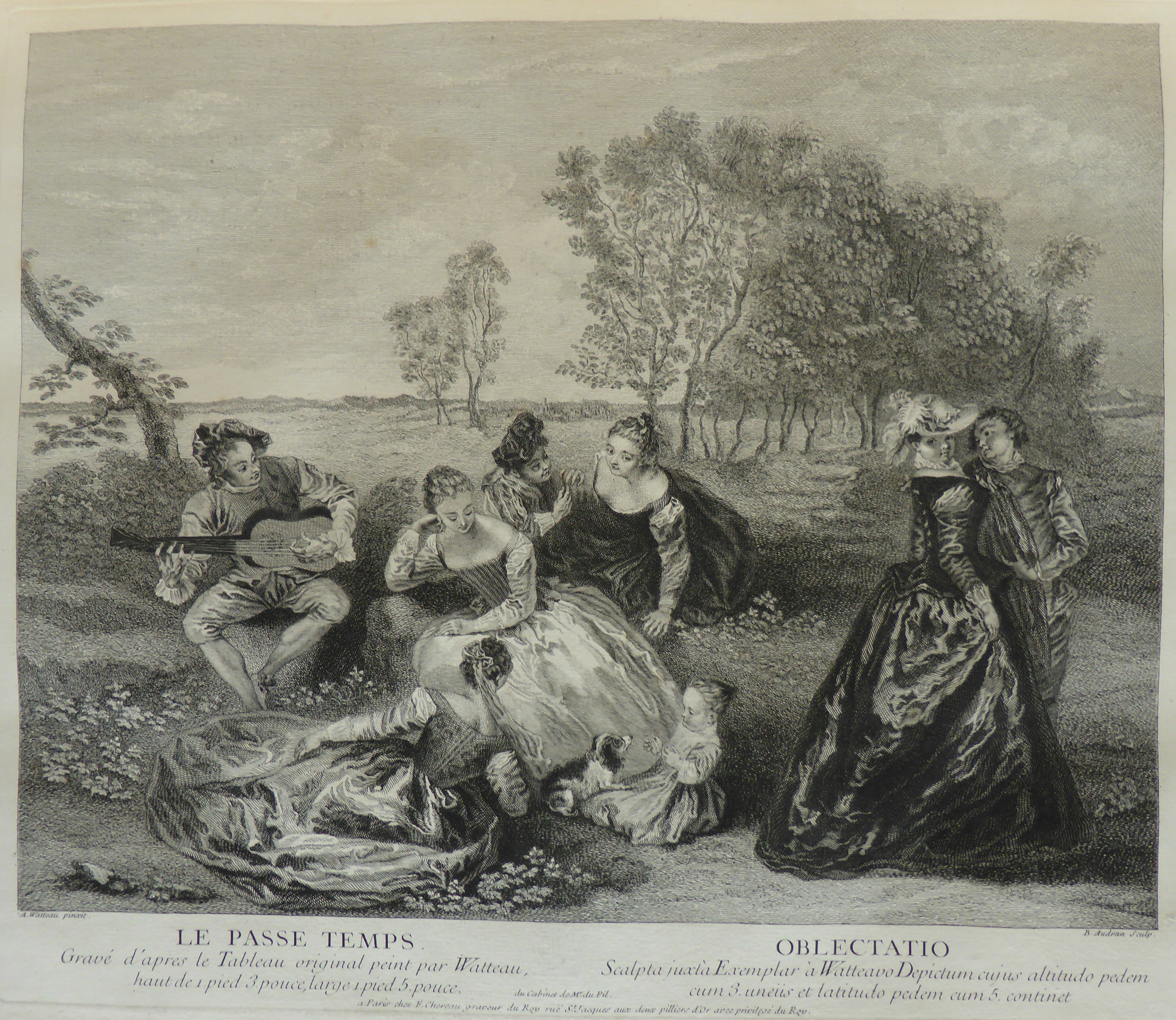
Benoît Audran after Watteau, Le Passe-temps, c. 1729, engraving.
Le Passe-temps was engraved in reverse by Benoît Audran. The print was announced for sale in the April 1729 issue of the Mercure de France, page 753.
PROVENANCE
Paris, collection of Jacques André Dupille [Du Pile] (1740), trésorier général de l’ordinaire des guerres. Noted on Audran’s engraving: “du Cabinet de M. du Pille.”
Paris, with Jean-Baptiste Pierre Lebrun (1748-1813; painter and art dealer). His sale, Paris, April 11ff, 1791, lot 200: “PAR LE MÊME [ANTOINE WATTEAU]…Un paysage où l’on voit 8 figures, don't un homme assis jouant de la guitare, tandis que les uns, en repos, l’écoutent, et que d’autres se promènent. Ce tableau, de la belle manière de Watteau, est une de ses belles compositions: il est gravé dans son oeuvre, par B. Audran, sous le titre du passé-temps. Hauteur, 14 pouces et demi; largeur, 17 pouces.” Sold for 199.19 livres according to the annotated copy of the sale catalogue in the Rijksbureau voor Kunsthistorische Documentatie.
SELECT BIBLIOGRAPHY
Hédouin, “Watteau” (1845), cat. 9.
Hédouin, Mosaïque (1856), cat. 92.
Goncourt, Catalogue raisonné (1875), cat. 151.
Réau, “Watteau” (1928), cat. 144.
Dacier, Vuaflart, and Hérold, Jean de Jullienne et les graveurs (1921-29), 3: cat. 185.
Adhémar, Watteau (1950), cat. 174.
Roland Michel, Watteau (1981), cat. 185.
Roland Michel, Watteau (1984), 156.
Rosenberg and Prat, Watteau, catalogue raisonné des dessins (1996), cat. 221, 229, 267, 490, 429, R 716.
RELATED DRAWINGS
Despite the clarity of the eight figures in this composition, only three of the artist’s drawings can be directly linked with Le Passe-temps.
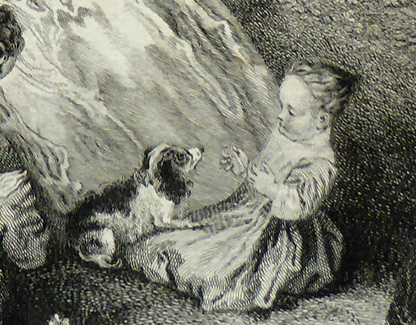
Benoît Audran after Watteau, Le Passe-temps (detail).
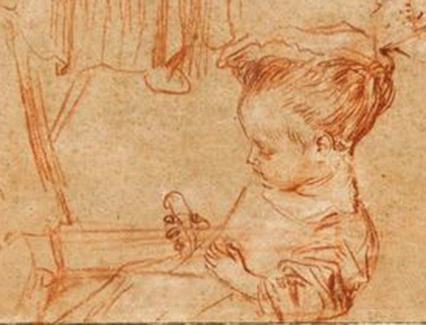
Watteau, Studies of Eight Figures (detail), red, black, and white chalk, Paris, Musée du Louvre, Département des arts graphiques.
The study of a child at the bottom of a well-known sheet in the Louvre (Rosenberg and Prat 229) provided the basis for the child in the foreground of Le Passe-temps. Watteau evidently favored this figure and also employed it in Les Charmes de la vie and L’Assemblée galante. In that the child in Le Passe-temps was in the opposite direction of the drawing, Watteau must have employed a counterproof.
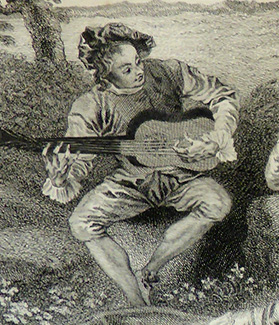
Benoît Audran after Watteau, Le Passe-temps (detail).
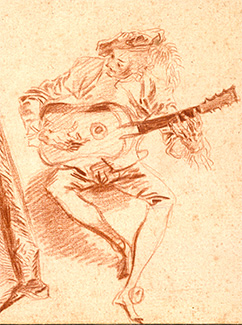
Watteau, A Standing Woman and a Seated Guitarist (detail), red chalk. Oxford, Ashmolean Museum.
The seated guitarist in Le Passe-temps was based on a study in the Ashmolean Museum (Rosenberg and Prat) 267) and was used with little perceptible change. Roland Michel cited the guitarists in Watteau’s La Surprise in the Getty Museum and in the Donneur de sérenade in Chantilly, but while those musicians play the same musical instrument, they strike different poses.
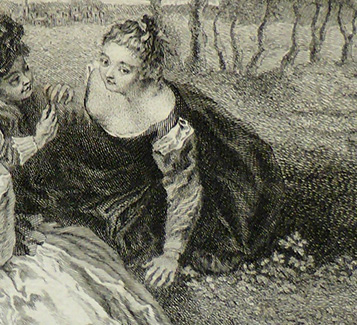
Benoît Audran after Watteau, Le Passe-temps (detail).
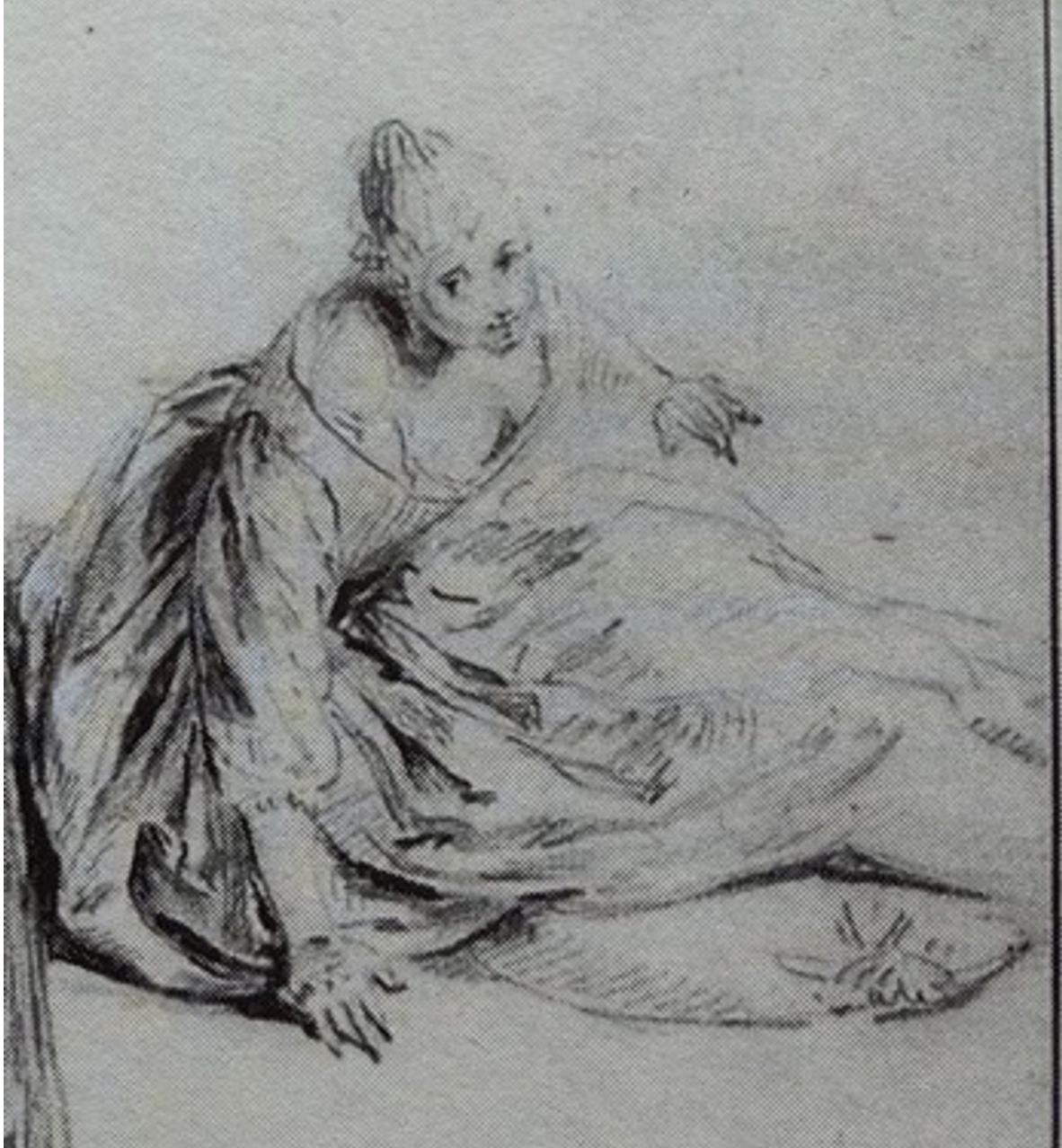
Watteau(?), Two Studies of Women (detail), whereabouts unknown.
The woman reclining on the grass and tilting forward at an angle can be traced to a Watteau study formerly in the collection of John Nicolas Brown (Rosenberg and Prat 221a). Although Rosenberg and Prat consider this sheet to be a copy after a lost drawing, it is a sensitive study of high quality. The same study from model was used for his Récreation italienne in Berlin.
REMARKS
Unseen since the eighteenth century, Le Passe-temps has not attracted the attention of critics. It has gone unmentioned by such scholars, as Réau, Temperini, Posner, and Glorieux. Yet it is a mature work with great presence. The few, proportionately large figures exude a remarkable mood of languid contentment. Adhémar classified this painting among those executed in late 1716, and Roland Michel came to a similar conclusion. The drawings associated with the painting have also been dated to this portion of Watteau’s career.
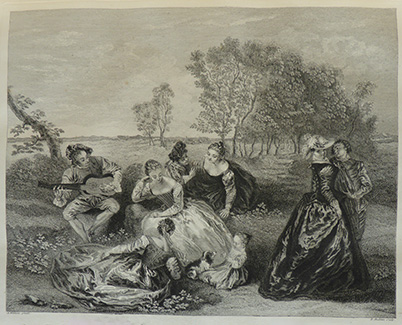
Benoît Audran after Watteau, Le Passe-temps, engraving.
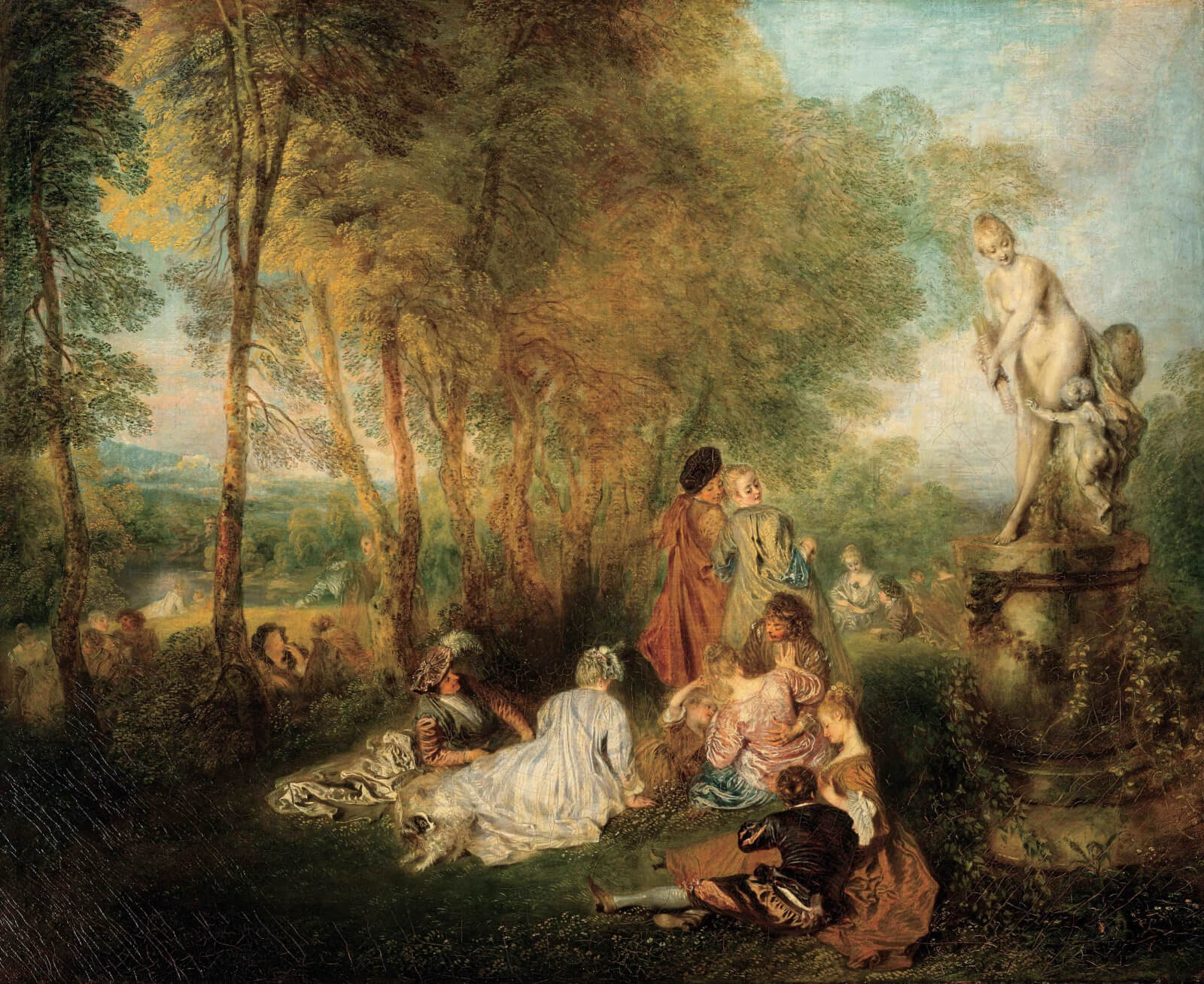
Watteau, Plaisirs d’amour, oil on canvas, 61 x 75 cm. Dresden, Gemäldegalerie
The distinctive structure of Le Passe-temps resembles elements seen in other of his mature works like Plaisirs d’amour in Dresden. The scale of the figures, the diagonal thrust of the trees, the contrast between the seated figures and the couple strolling away—all these features bind the two works.