
- Home Page
- Accepted
Paintings & Copies - Doubtful
Attributions - Doubtful Textual References
- Alternative
Titles - Collectors &
Museums - Bibliography
- Search Abecedario
- Watteau &
His Circle
Paysage à la cascade
April 2026
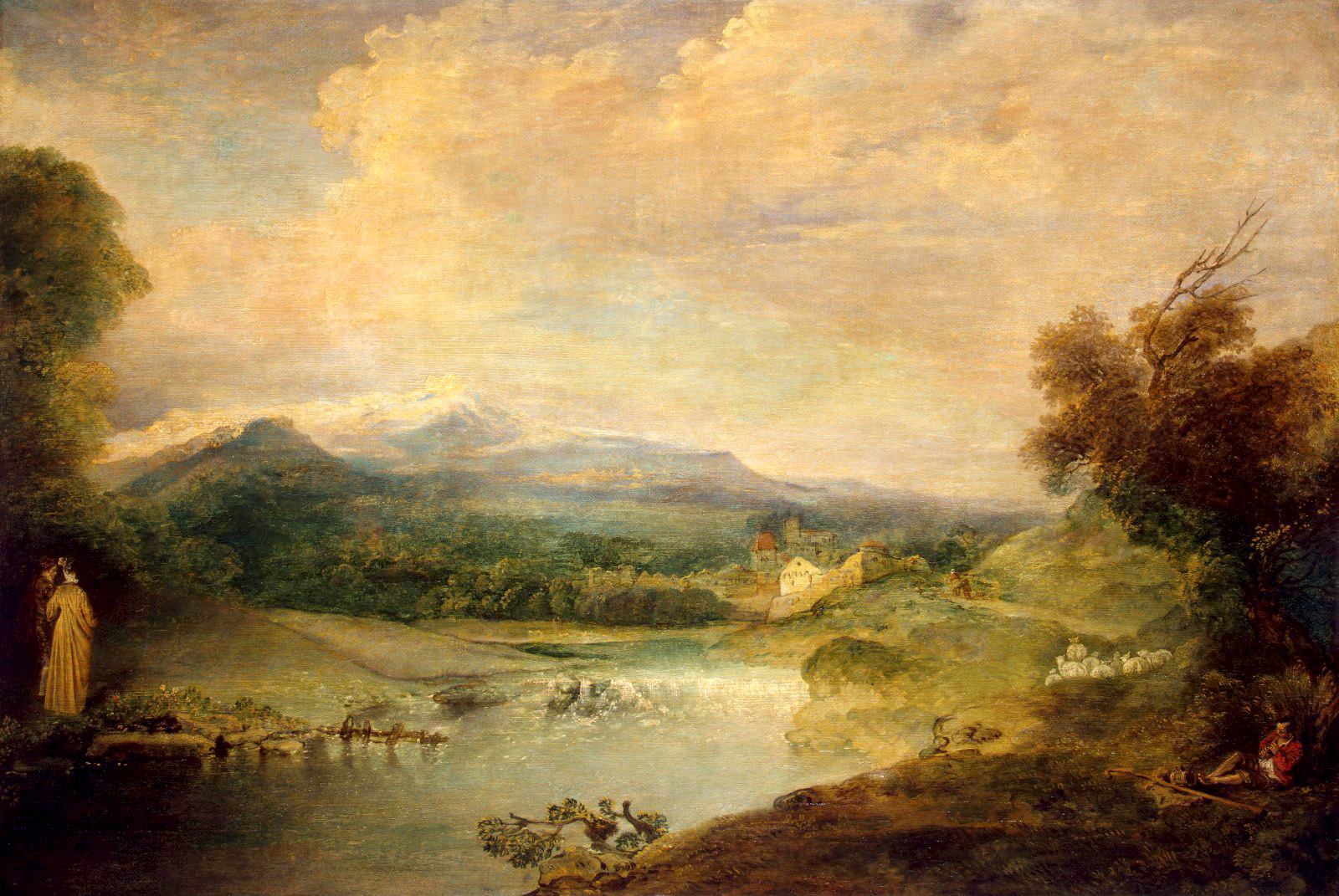
St Petersburg, Hermitage Museum, inv. 7766
Oil on panel, transferred to canvas
70 x 106 cm
ALTERNATIVE TITLES
Landscape with a River
Landscape with a Waterfall
Paesaggio con cascata
Paysage à la rivière
Paysage au chute d’eau
Paysage avece une cascade et un jouer de flûte
Paysage avec un torrent
Le Pont à la cascade
PROVENANCE
Collection of Count A. P. Chaewlov (Chuvalov).
Kalouga, Collection Boulitchov (Bulychev).
Kalouga, Museum.
Transferred to the Hermitage, St. Petersburg, c. 1933.
EXHIBITIONS
Bordeaux, Musée, Chefs d’oeuvre (1965), cat. 44 (as Watteau, Paysage a la cascade, lent by the Musee de l’Ermitage, Leningrad).
Paris 1965, Chefs d’oeuvre de la peinture française dans les musées de Leningrad et de Moscou, cat. 42 (as Watteau, Paysage à la cascade, lent by the Musée de l‘Hermitage, Leningrad).
Washington, Paris, Berlin, Watteau 1684-1721 (1984), cat. P 33 (as Watteau, Landscape with a River [Paysage à la rivière], lent by the Hermitage, Leningrad).
SELECT BIBLIOGRAPHY
Josz, Watteau (1904), 178.
Bessonov, Guide du Musée de Kalougas (1929), 34.
Leningrad, Hermitage, Western European Art (1958), 1: 270, cat. 7766.
Wildenstein, “Y a-t-il des toiles apocryphales?” (1965), 31.
Chastel, “Les Tableaux français de Russie” (1965), 11.
Nemilova, Watteau and His Works (1964), 60-68,158,182.
Cailleux, “Newly Identified Drawings” (1967), 59.
Macchia and Montagni, L’opera completa di Watteau (1968), cat. 38.
Ferré, Watteau (1972), 1: 94, 138, 214.
Cailleux, Review “Watteau and His Times” (1972), 734.
Nemilova, French Paintings of the Eighteenth Century in the
Hermitage, Scientific Catalogue (1982), no. 46.Roland Michel, Watteau (1981), cat. 126.
Roland Michel, Watteau (1984), 159-60, 201, 300.
Nemilova, French Painting, Eighteenth Century (1986), 448, cat 349.
Rosenberg and Prat, Watteau, Catalogue raisonné des dessins (1996), cat. 98, 343.
Börsch-Supan, Watteau (2000),114.
Temperini, Watteau (2002), cat. 38.
Glorieux, Watteau (2011), 213-15.
Valenciennes, Musée, Rêveries italiennes (2015), 94-95.
REMARKS
The early history of this landscape is obscure. Off in remote Russia, it was ignored by most Western critics until the early twentieth century. In 1833it was transferred from panel to canvas and was overpainted, none of which helped it gain a favorable reception. While it was still in the Kalouga museum, it was attributed to an artist in the Watteau circle, but not to the master himself. It was only after World War II that the Hermitage began a campaign of exhibiting this work in Western countries and, more importantly, attributing the picture to Watteau. Unconvinced, its detractors were more numerous than its supporters. Not traceable to eightenth-century collections and not included in the Oeuvre gravé, doubters felt justified in rejecting the work. Sidorov’s unwarranted insertion of the out-of-scale couple and large tree at the left side of the composition added ammunition to the nay-sayers‘ arguments. Neither de Goncourt nor Zimmerman, not even Réau and Adhémar, included the painting in their catalogues raisonnés of Watteau‘s painting. Despite Mathey‘s many questionable attributions of other dubious paintings to Watteau, not even he considered it among Watteau’s works. When an exhibition of French paintings from Russian museums came to Paris in 1965, the landscape was rejected by Georges Wildenstein in Le Figaro and by André Chastel in Le Monde. Ferré called it a “faux impudent“ (brazen fake). Macchia and Montagni opined that it “does not look much like a Watteau.“ After all, the picture was not backed by a long history of acceptance, and the overpainting was a serious impediment. Then the tide turned. Since the late 1960s, an increasing number of scholars have accepted the picture as a Watteau. Rosenberg, Temperini, and Glorieux have all admitted the painting to Watteau’s oeuvre.
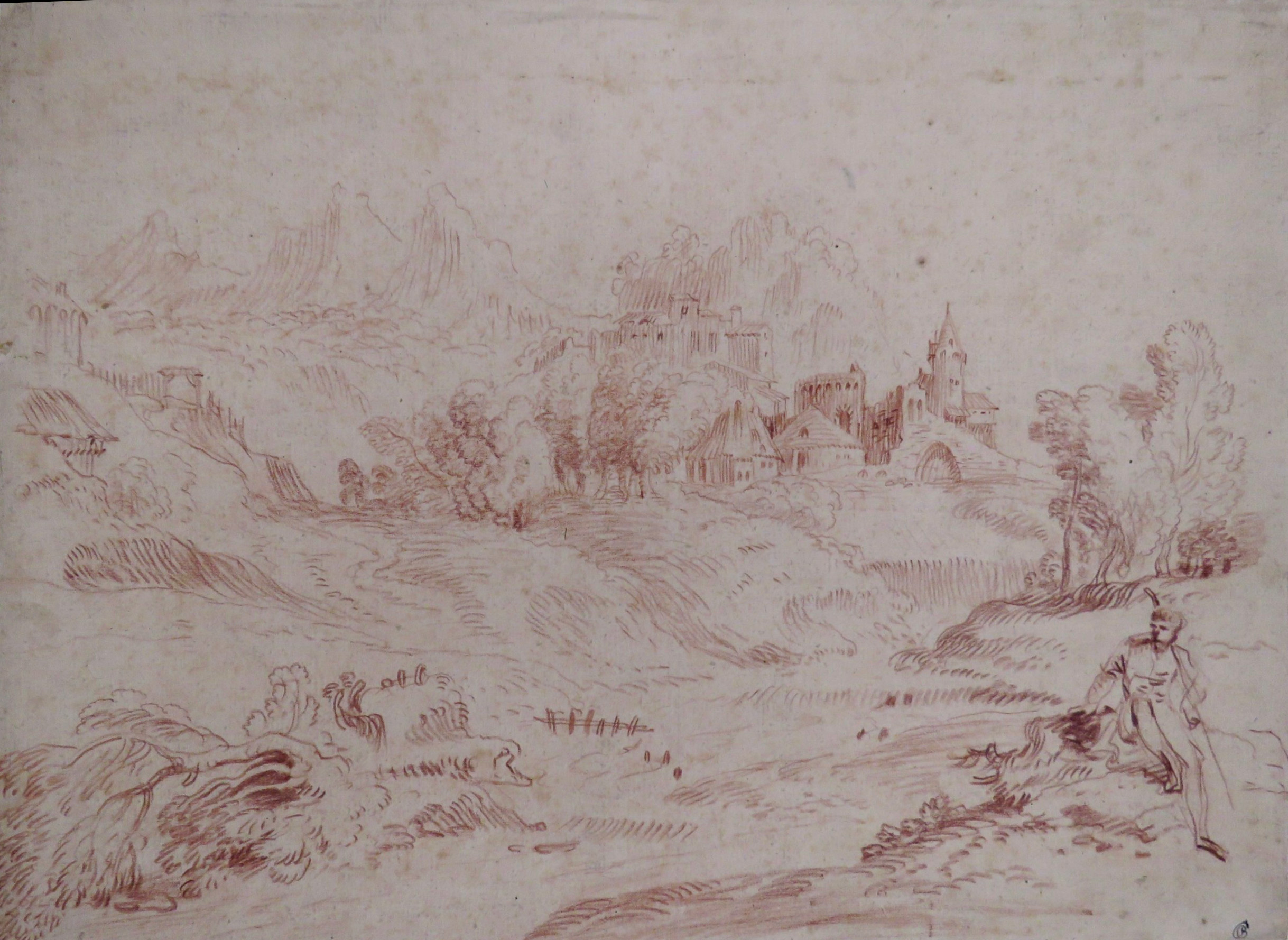
Watteau after Domenico Campagnola, Landscape with a Shepherd, red chalk, 320 x 439 cm, Oxford, Ashmolean Museum.
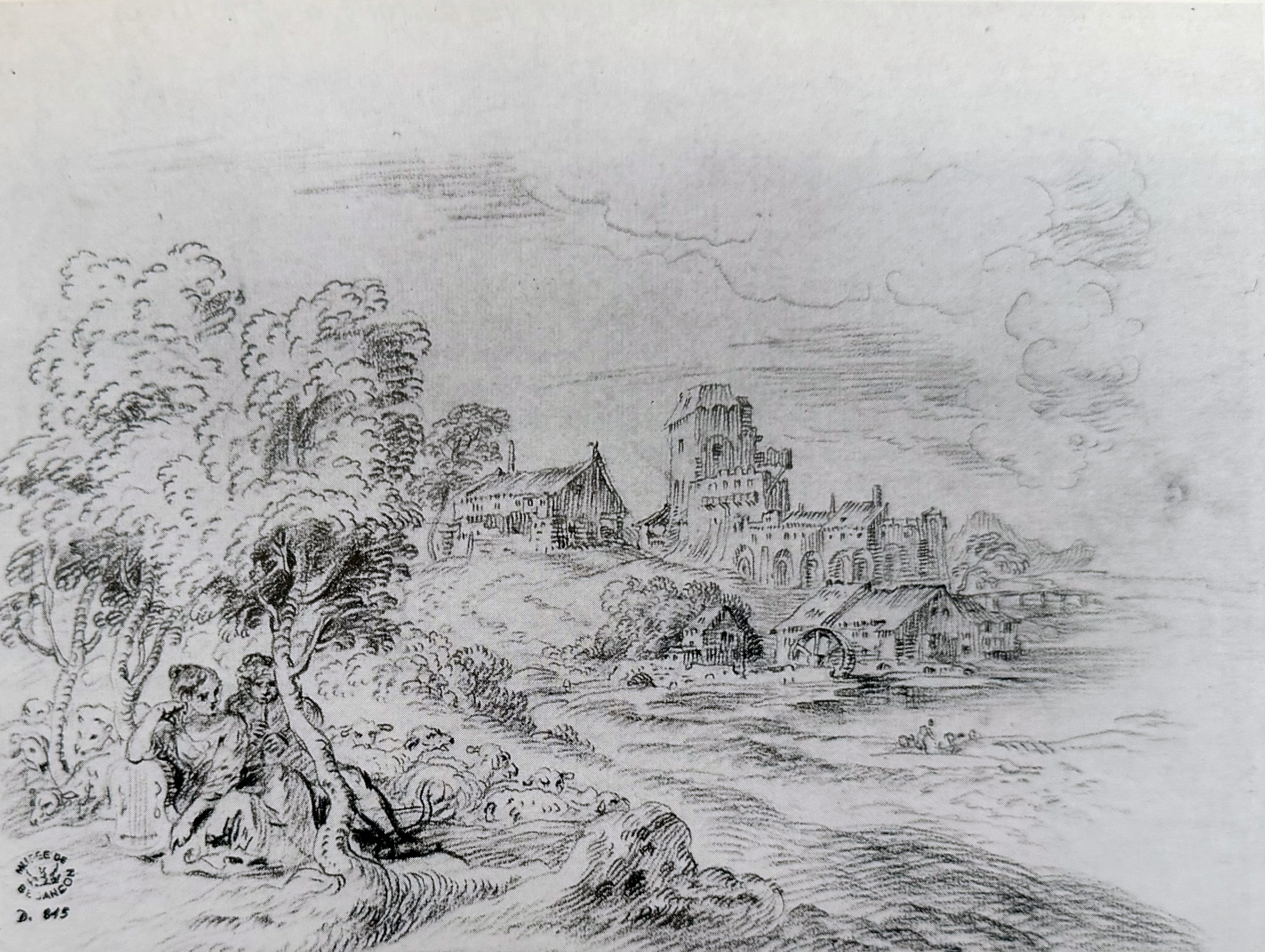
Watteau after Domenico Campagnola, A Patoral Concert, red chalk, 192 x258 cm, Besançon, Musée des beaux-arts et d’archéologie.
Roland Michel and Rosenberg have proposed analogies between the Hermitage painting and various Watteau drawings after Campagnola. Indeed, there is much justification for this. Critics frequently cite a Watteau drawing after Campagnola in the Ashmolean Museum (Rosenberg and Prat 343) but even more comparable is a Watteau study after Campagnola now in Besançon’s Musée des beaux-arts (Rosenberg and Prat 430). In reverse, it could serve as the ground plan for the Hermitage canvas. At the far side, seated in the shade of small trees, are amorous shepherds, with the man playing a flute just as in the Hermitage picture. Beyond them is the herd of animals they are supposedly tending—cows in Besançon, sheep in St. Petersburg. Running across both landscapes is a wide river, each with the water bubbling over a small waterfall. Perhaps most important of all is the mood that pervades both works. Music, love, the beauty of a verdant landscape—all these elements combine in these idyllic scenes. The modern tendency is to name the painting after the small cataract or the river, it would be more germane to focus on the flutist, his concertizing, and the theme of pastoral love.
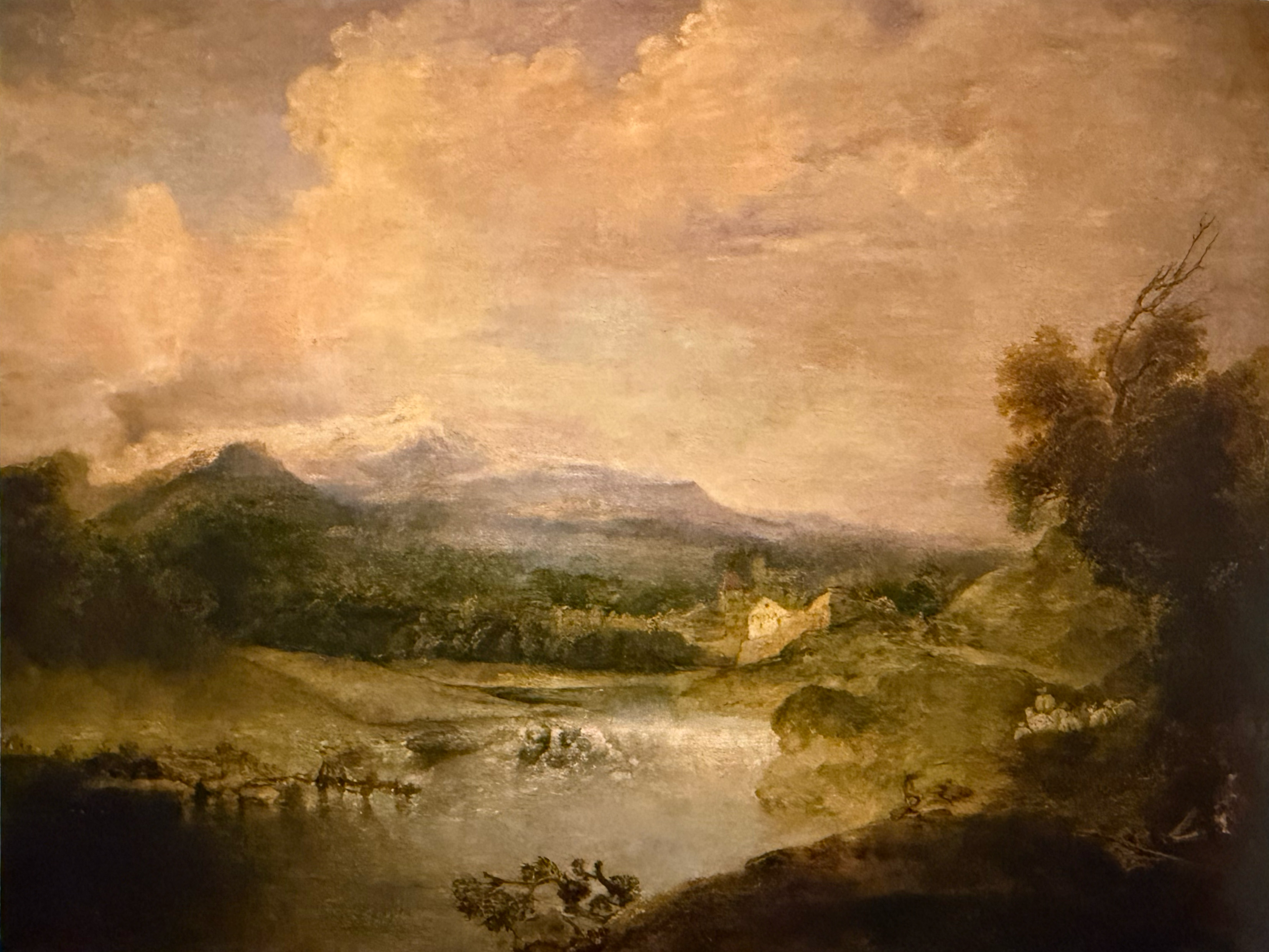
If Sidor’s overpainting of Watteau’s picture could be removed, as have attempted in the accompanying image, we might have a better sense of what Watteau originally intended. The results is striking! Without the strolling couple and ump of a tree at the left , the resulting composition is so much closer to the Campagnola drawings. The sense of scale and space is much lighter and inviting.
Disregarding its troubled past, most contemporary scholars accept Watteau’s authorship of the painting and, to a degree, agree on its date of execution. Most favor the artist’s mid career. Early on, the Hermitage, Roland Michel, and Temperini proposed 1713-1714 but that early dating has given way. By the 1960s opinion had shifted to circa 1714-15. Rosenberg suggested that it must have been executed after 1715, after Crozat returned from Italy with a large collection of Titian and Campagnola drawings. Glorieux has proposed c. 1715-1716, while Börsch-Supan and the Rêveries italiennes exhibition have supposed c. 1716.
Despite the emphasis on “waterfall“ and “river“ in the painting‘s various titles, greater attention should be paid to the flutist at the far right. In its original state, without Sidor's additions, with just the landscape and the lone flutist, Watteau’s closeness to the Venetian ideal of poesia would be more apparent. If only the painting could be restored to its original appearance.