
- Home Page
- Accepted
Paintings & Copies - Doubtful
Attributions - Doubtful Textual References
- Alternative
Titles - Collectors &
Museums - Bibliography
- Search Abecedario
- Watteau &
His Circle
La Villageoise
Entered September 2026
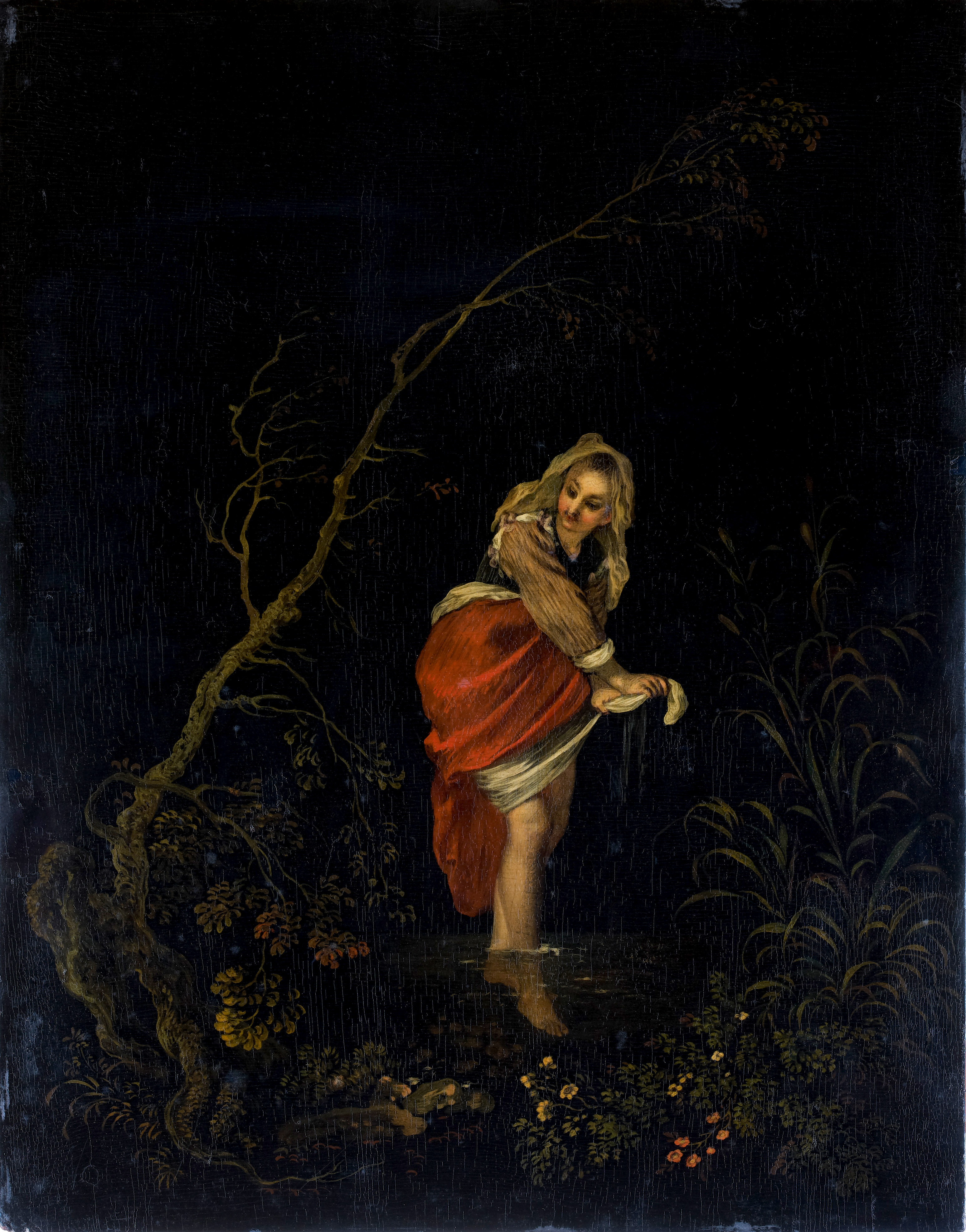
© Cabinet Turquin
Paris, private collection
Oil on lacquered panel
38 x 29.5 cm
ALTERNATIVE TITLES
Das Dornfmädchen
A Girl Wading a Stream
A Girl Wading in a Stream
Jeune fille passant un gué
RELATED PRINTS
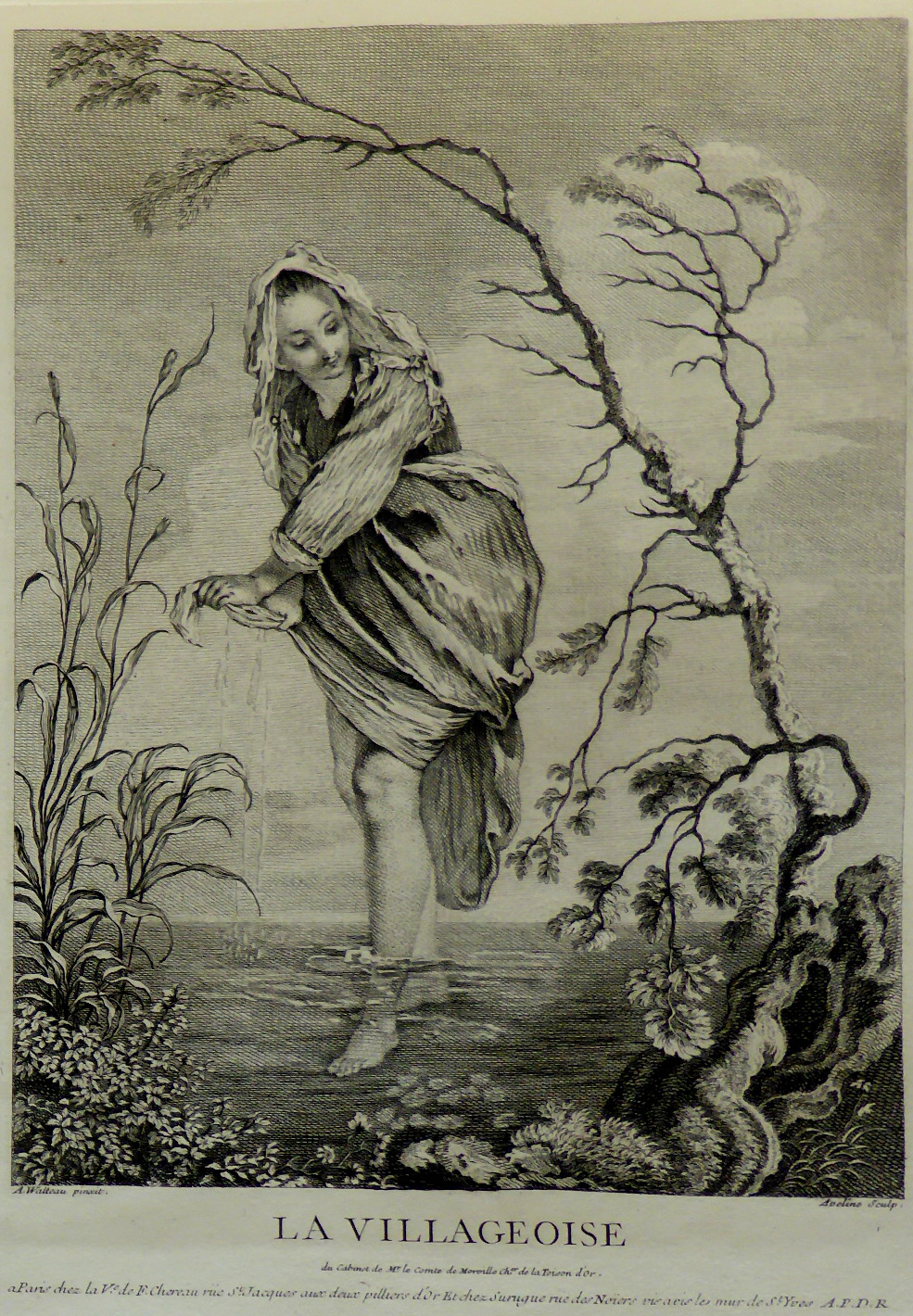
Pierre Aveline after Watteau, La Villageoise, engraving, c. 1731.
Watteau’s La Villageoise was engraved in reverse by Pierre Aveline for Jean de Jullienne’s Oeuvre gravé. The print was announced for sale in a 1731 issue of the Mercure.
PROVENANCE
Paris, Château de La Muette, collection of Joseph-Jean-Baptiste Fleuriau d’Armenonville (1661-1728; statesman). By descent to his son, Charles-Jean-Baptiste Fleuriau.
Paris, collection of Charles-Jean-Baptiste Fleuriau, comte de Morville (1686-1732; statesman). His ownership is specified on the 1731 engraving by Aveline.
Paris, collection of Georges Edouard Warneck (1834-1924; art collector and dealer). His sale, Paris, Galerie Georges Petit, May 27-28, 1926, lot 114: “Antoine WATTEAU . . . La Villageoise.—Panneau en laque. Sur un fond de laque noir, se détache une jeune paysanne debout, les pieds dans l’eau, la jupe rouge retroussée, todant les deux mains son jupon blanc qui s’était mouillé. Entourage de rousseaux, fleurs et arbuste. Cadre en laque à ornements dorés. Bois. Haut., 38 cent.; larg., 29.5 cent.
Le même sujet se retrouve en sens inverse, dans la gravure par Aveline, d’après Wattaeu, portant le titre: «La Villageoise, du cabinet de Mr le Comte de Morville». La gravure est jointe. Comparer Edm. De Goncourt: Catalogue raisonné de l’oeuvre peint, dessiné et gravé d’Antoine Watteau (Paris, 1875), pp. 83-84.” According to Adhémar, the painting sold to Bezançon de Wagner.Cannes, collection of M. Bezançon de Wagner. By descent to the Comtesse d’Ancourt.
Collection of the Comtesse d’Ancourt. Her sale and others, London, Sotheby’s, March 21, 1973, lot 23: “JEAN-ANTOINE WATTEAU . . . A GIRL WADING A STREAM (‘LA VILLAGEOISE’) / A girl in a red skirt and striped sleeves standing in a stream, wringing out her petticoat; on a black ground / On lacquered panel, unframed. 15 in. by 11 ½ in. 38 cm. by 29.5 cm. This panel belonged to Charles-Jean-Baptiste Fleuriau, Comte de Morville, and was engraved when in his collection by Pierre Aveline. It was probably painted for the Count’s father, Joseph-Jean-Baptiste Fleuriau d’Armenonville. Fleuriau d’Armenonville was in possession of the royal Château de La Muette, near Paris, from about 1707mto about 1717 and commissioned Claude Audran to decorate it. Most or all the work was entrusted by Audran to Watteau, and it seems likely that the present picture was one of the decorative panels that Watteau painted for the château. It is dated c. 1707-1708 by Mme. Adhémar (see Literature); others have suggested a later date.
Engraved before 1732 by Pierre Aveline (as La villageoise) in the second volume of L’Oeuvre d’Antoine Watteau gravé d’après ses tableaux, as in the collection of the Comte de Morville (the engraving is in the opposite direction and there are slight differences in the foliage and a vaguely indicated sky).
Collections: Probably in the Collection of Joseph-Jean-Baptiste Fleuriau d’Armenonville; In the Collection of his son, Charles-Jean-Baptiste Fleuriau, Comte de Morville (died 1732); Acquired from a descendant of the Comte de Morville by E. Warneck, Paris; E. Warneck sale, Paris, 1926, purchased by M. Bezançon de Wagner, whence by descent to the present owner . . .” The painting bought in at £30,000. The consignor’s name is recorded in an annotated copy of the sale catalogue in the Sotheby’s archive.Munich, with Galerie Bantele-München. Advertised in Die Weltkunst, July 15, 1974.
Paris, with Hubert Duchemin, March and April 2013, from a French collector who supposedly bought it from Mme. Bezançon de Wagner.
EXHIBITIONS
Bordeaux, Musée, Paris et les ateliers parisiens (1958), cat. 37 (Watteau, La Villageoise, lent by M. Besançon de Wagner)
SELECT BIBLIOGRAPHY
Hédouin, “Watteau” (1845), cat. 47.
Hédouin, Mosaïque (1856), cat. 48.
Goncourt, L’Art au XVIIIème siècle (1860), 57.
Goncourt, Catalogue raisonné (1875), cat. 90.
Mollet, Watteau (1883), 66.
Dacier, Vuaflart, and Hérold, Jean de Jullienne et les graveurs (1921-29), 1: 26, 263; 2: 58, 93, 96, 121, 133; 3: 77, cat. 157.
Miller, “The Borrowings of Watteau” (1927), 43.
Réau, “Watteau” (1928), cat. 167.
Adhémar, Watteau (1950), cat. 15.
Macchia and Montagni, L’opera completa di Watteau (1968), cat. 27.
Roland Michel, Watteau (1981), cat. 102.
Rosenberg and Prat, Watteau, Catalogue raisonné des dessins (1996), under cat. 311.
Scott, “Games with Otherness” (2003), 197-98, note 34.
Michel, Le «célèbre Watteau» (2008), 137.
Plomp and Sonnabend, Watteau: Der Zeichner (2016), under cat. 62.
Miller, “The Borrowings of Watteau” (1927), 43.
RELATED DRAWINGS
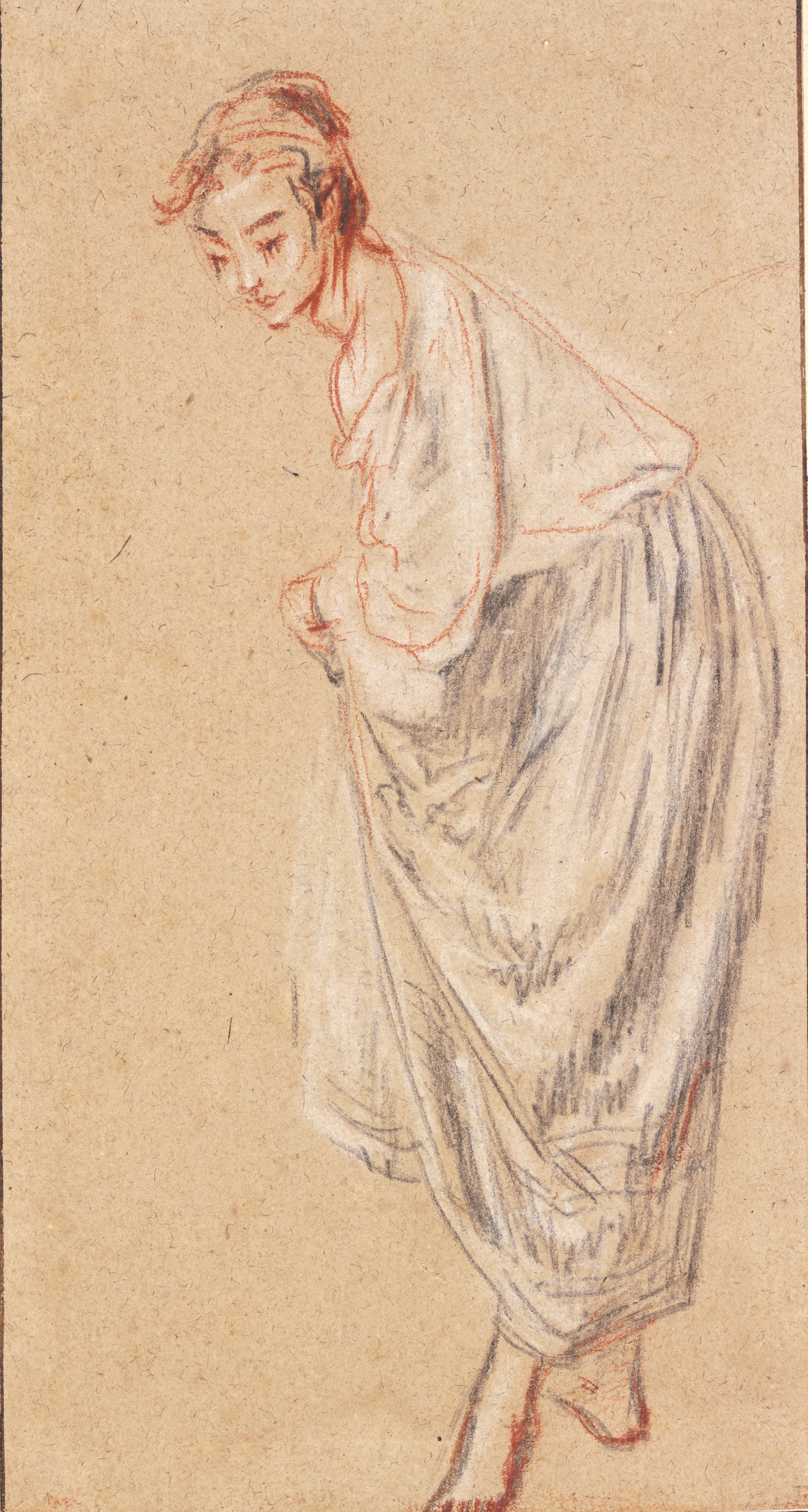
Watteau, Study of a Woman Lifting Her Skirt, red, black, and white chalk, 26,4 x 14 cm. Frankfurt, Städel Museum.
Although the specific drawing that Watteau used for this painting has not survived, something of its appearance can be surmised through a related drawing in Frankfurt (Rosenberg and Prat 311). The Frankfurt study appears to have been made from the same model as the one used for La Villageoise. Originally they might even have been drawn on the very same sheet. Although the Frankfurt drawing’s single figure fills the page, the sheet was evidently still wider, and a more horizontal format could have accommodated a second and even a third figure.
REMARKS
This rustic subject of a young peasant girl crossing a stream, her skirts decorously lifted and loosely gathered to keep them as dry as possible, seems at first to be inconsistent with the elegant, courtly women who glide through the artist’s fêtes galantes. Yet such simple rural subjects are a vital aspect of his oeuvre. Paintings such as La Fileuse, La Danse champêtre, and L’Indiscret remind us that Watteau was occasionally drawn to such unpretentious peasant scenes. Moreover, when he ventured into this genre, he often chose pretty young women as his subject.
Watteau’s La Villageoise was not entirely hidden from sight in the second half of the twentieth century, yet it received little attention from scholars. Of those who commented on it, most considered it an early work because of its rural subject and its association with the Figures chinoises et tartares at the château de la Muette. Adhémar dated it c. 1708-09, when Watteau was associated with Claude Audran and the decoration at La Muette. So too did Macchia and Montagni, as well as Rosenberg and Prat who proposed c. 1708 or slightly later. On the other hand, Roland Michel preferred a still later date of c. 1710-12.
The provenance of this painting from the comte de Morville, the son of Fleuriau d’Armenonville, who commissioned the Figures chinoises et tartares from Audran and Watteau, heavily influences our understanding of this panel. We would propose that the principal aspects of the picture–a single figure set against a black lacquer ground, and with only the slightest indication of ground and sky—reflect the basic appearance of the decoration at La Muette. Dacier, Vuaflart, and Hérold suggested that La Villageoise was a preparatory sample made before the artist began the La Muette cycle. Those modern scholars who essentially deny any relation between La Villagoise and La Muette are, in our view, like ostriches with their heads in the sand, refusing to recognize the kinship of the two. Yet we do not know exactly how La Villageoise was employed. Its Western subject differentiates it from the chinoiseries at La Muette. Was it part of the decoration from another room in the château or, less probable, was it an independent painting? The garland-like effect at the bottom suggests that it was part of a decorative scheme.
For copies of La Villageoise, CLICK HERE