
- Home Page
- Accepted
Paintings & Copies - Doubtful
Attributions - Doubtful Textual References
- Alternative
Titles - Collectors &
Museums - Bibliography
- Search Abecedario
- Watteau &
His Circle
La Mariée de village (copy 1)
Entered February 2026; revised September 2026
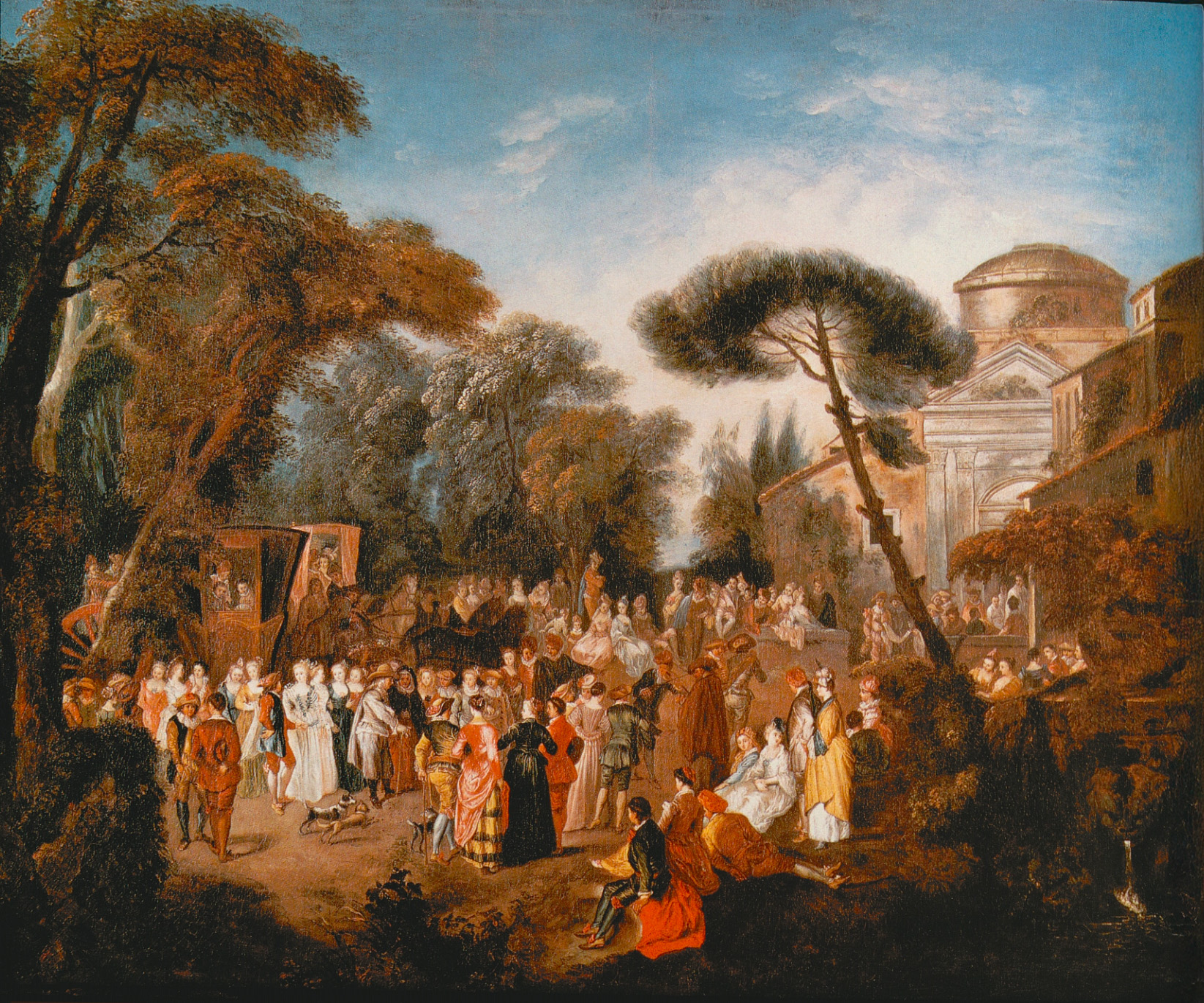
Whereabouts unknown
Oil on canvas
72.5 × 91 cm
PROVENANCE
Paris, with Victor Alvin-Beaumont (1862-1942; artist, dealer, critic) by 1925.
Paris, with Galerie Pardo (advertise L’Oeil, December 1969, 88-9; July-August 1975, 66).
SELECT BIBLIOGRAPHY
Alvin-Beaumont, Watteau: “la Mariée de Village” (1925).
Réau, “Watteau” (1928), under cat. 89.
Rey, Quelques satellites (1931), 154-56.
Alvin-Beaumont, Le Pedigree (1932), 39-46.
Adhémar, Watteau (1950), under cat. 53.
Washington, Paris, Berlin, Watteau 1684-1721 (1984), under cat P. 11.
L’Oeil (December 1969), 88.
L’Oeil (July-August 1975), 66.
Eidelberg, “Defining the Oeuvre of Bonaventure de Bar” (Part 2), cat. X4.
REMARKS
Victor Alvin-Beaumont, who owned the painting in the early twentieth century, claimed that his canvas was the original by Watteau. He considered the Potsdam painting to be a copy by Bonaventure de Bar, commissioned by its first owner, Lériget de La Faye, who then gifted it to the Comtesse de Verrüe. When the painting reappeared several decades later, in 1969, it was with the Pardo Gallery and was still attributed to Bonaventure de Bar. On the other hand, Réau thought that the Alvin-Beaumont painting was by Pater. Despite these attributions to Watteau and his satellites, the painting remains just an anonymous copy La Mariée de village. It corresponds to the direction of Watteau’s canvas in Berlin.
 |
La Mariée de village (copy 2)
Entered February 2026; revised September 2026

Whereabouts unknown
Oil on panel
61 × 82 cm
PROVENANCE
Bordeaux, Madame Veuve Gergonne (antiquarian); sold to Paul Fourché in 1912.
Bordeaux and Orléans, collection of Paul Fourché (1840-1922, dealer); he offered to donate it to the Louvre in December 1923, but the painting was refused by the museum.
SELECT BIBLIOGRAPHY
Adhémar, Watteau (1950), under cat. 53.
REMARKS
This copy, in the reverse direction of Watteau’s composition in Berlin, was executed after the engraving by Charles Nicolas Cochin), and has a false "Watteau" signature. According to a note in the Service de documentation, musée du Louvre, département de peintures). Jules Guiffrey saw the painting in Bordeaux and described it as “an old and mediocre copy of La Mariée de village without artistic interest and no financial value.” The records in the Orléans museum indicate that the painting did not enter their collection with other Fourché gifts.
|
La Mariée de village (copy 3)
Entered February 2026; revised September 2026
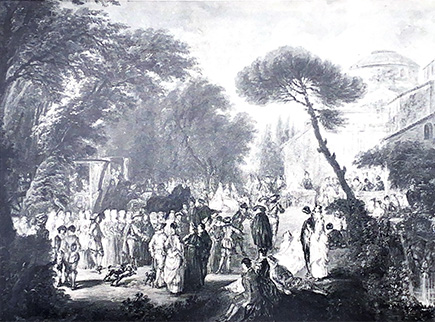
Whereabouts unknown
Oil on panel
26 × 35 cm
ALTERNATIVE TITLES
Der Brautzug
PROVENANCE
Vienna, sale, Dorotheum, September 21, 1971, lot 131: “Antoine Watteau, Kreis, Der Brautzug, Öl auf Holz, 26 x 35, variierte Replik des Gemaldes in ehemaligem Besitz des deutschen Kaiserhauses (siehe Abbildung Tafel 35)”. Sold for 45,000 Deutschmark.
REMARKS
The painting is a copy in the same direction as the original Watteau painting in Berlin.
|
La Mariée de village (copy 4)
Entered February 2026
Lisbon, Gulbenkian Foundation, inv. 254
Oil on paper, pasted on canvas
38 × 75 cm
ALTERNATIVE TITLES
The Bride of the Village
PROVENANCE
London, collection of Charles Robert Leslie (1794-1859; painter). His sale, Foster, April 25, 1860, lot 114: “WATTEAU. The Bride of the Village, sketch for the engraved picture, in perfect preservation. Mr. Leslie used to say, this picture looked as if it was painted with gold and honey.”
England, collection of Frederick Locker Lampson (1821-1895; man of letters) . His sale and others, London, Christie’s, December 20, 1918, lot 143: “A. WATTEAU . . . . LA MARIÉE DE VILLAGE. The arrival of the bridal coach, with numerous friends grouped in the garden before the entrance of a château. A sketch in oils on paper for the celebrated, engraved picture. 15 1l2 in. by 29 in. From the Collection of C. R. Leslie, R. A., 1860 / Exhibited at Burlington House, 1878.” Sold for £2,940 to Martin for Calouste Gulbenkian.
London and Lisbon, collection of Calouste Gulbenkian (1869-1955; banker); his bequest to the Gulbenkian Foundation.
EXHIBITIONS
London, Royal Academy, Old Masters (1878), cat. 253 (as by Watteau, lent by Frederick Locker Lampson).
SELECT BIBLIOGRAPHY
Adhémar, Watteau (1950), under cat. 53.
Washington, Paris, Berlin, Watteau 1684-1721, under cat. P 11.
REMARKS
This work on paper, once considered to be a sketch for Watteau’s picture, is a partial copy after Watteau’s canvas, and in the same direction as his composition.
|
La Mariée de village (copy 5)
Entered February 2026
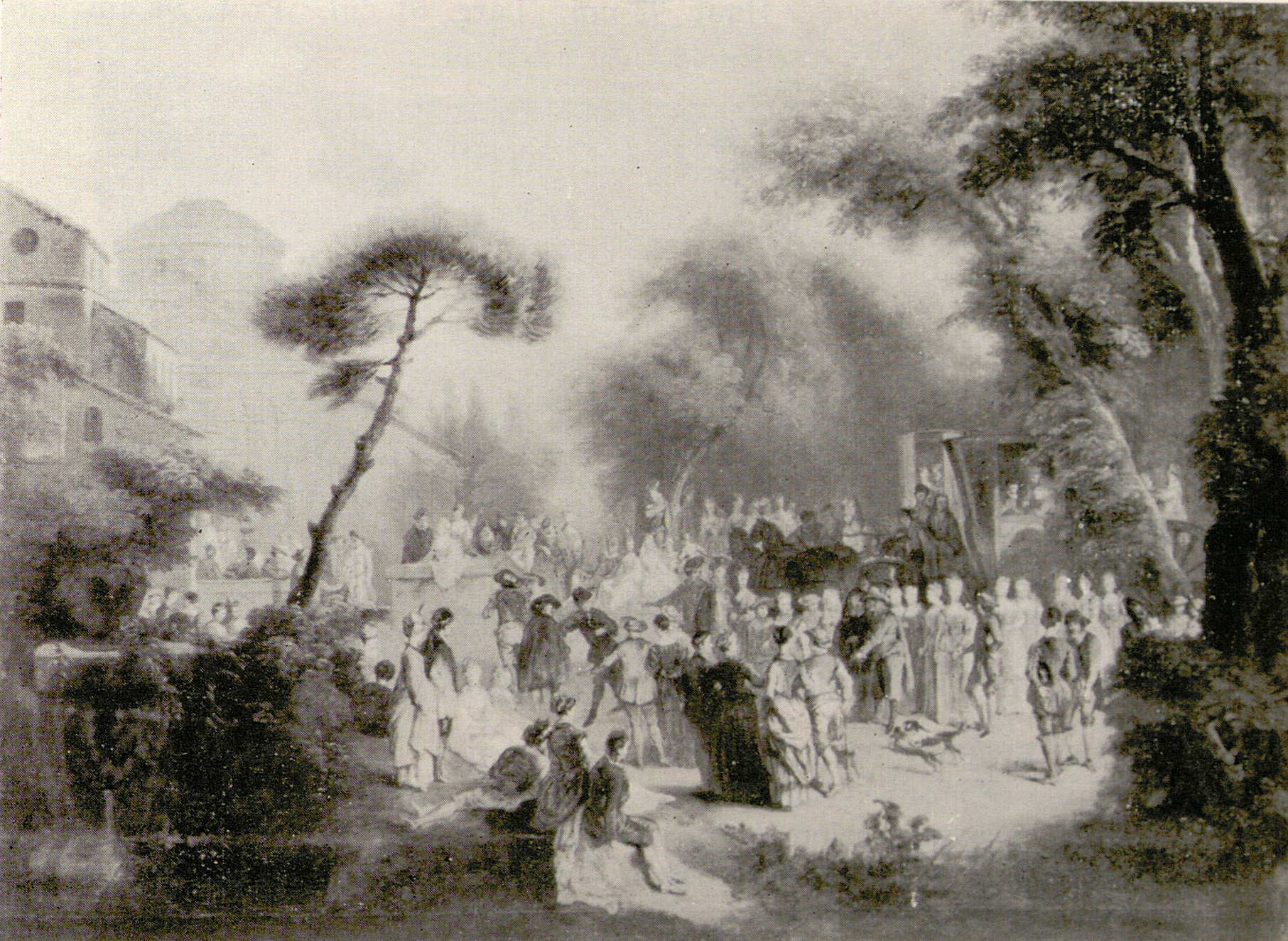
Whereabouts unknown
Oil on panel
60 [or 63] × 82 cm
ALTERNATIVE TITLES
La Réunion dans le parc.
PROVENANCE
Versailles, sale, Chapelle, November, 27, 1966, lot 48: “WATTEAU DE LILLE 48 — La mariée du village. Bois. (Fentes.) Cadre ancien en bois sculpté. Haut. 63 cm. Larg. 82 cm.”
Versailles, sale, Chapelle, Perrin, Fromantin, October 25, 1970, lot 58: “WATTEAU Antoine (Suite de). . . La réunion dans le parc. Bois. Cadre ancien, bois sculpté. Haut. 60 cm. Larg. 82 cm.”
REMARKS
This painting, in the reverse direction of Watteau’s composition, must have been executed after the print by Charles Nicolas Cochin.
|
La Mariée de village (copy 6)
Entered February 2026
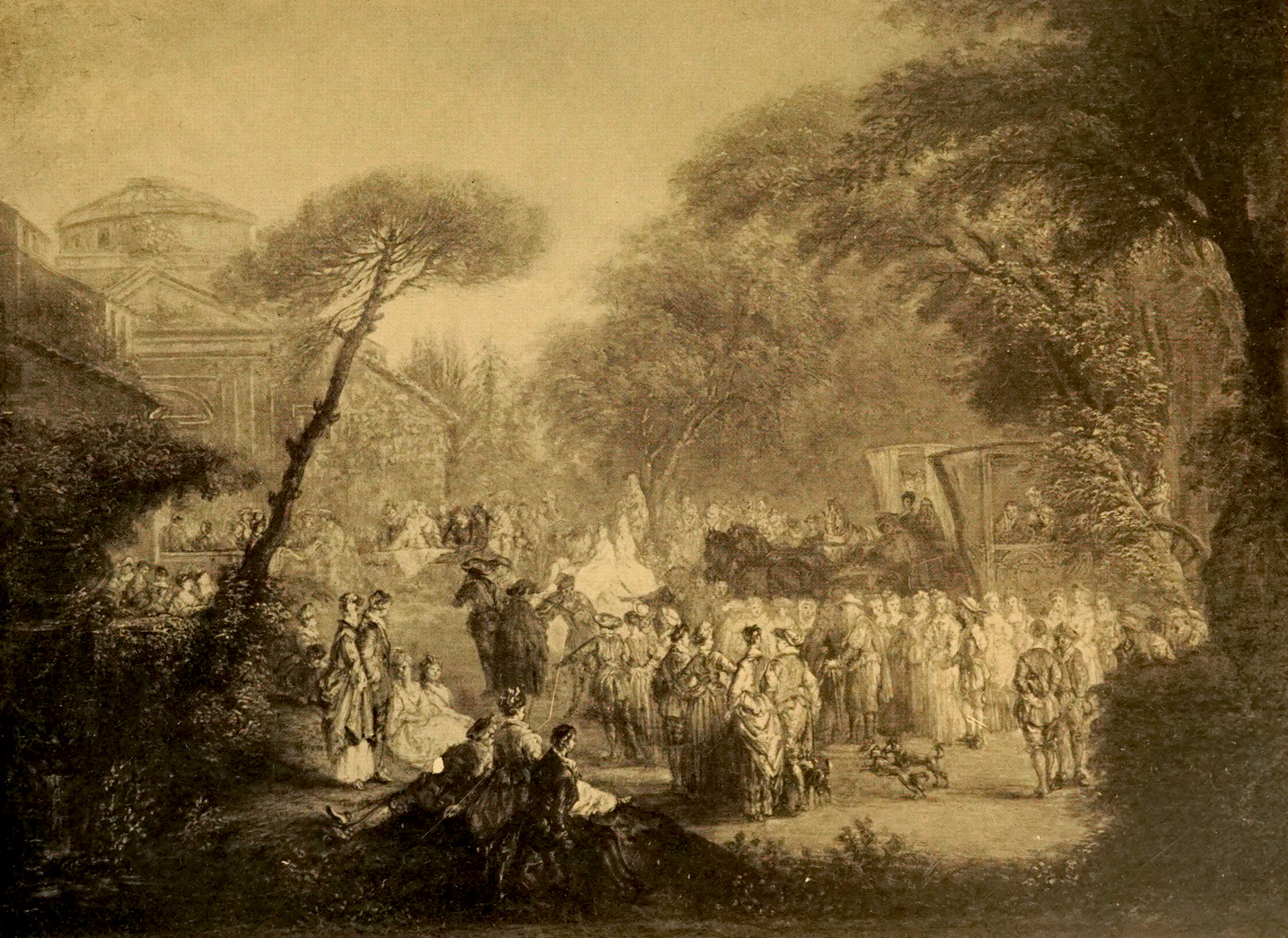
Whereabouts unknown
Oil on canvas
26.7 × 35.6 cm
ALTERNATIVE TITLES
Fête champêtre
PROVENANCE
New York, collection of Guy Reginald Bolton (1882-1979; Anglo-American playwright). His sale and others, New York, American Art Association, February 19, 1912, lot 96: “JEAN ANTOINE WATTEAU . . . FÊTE CHAMPÊTRE / Height, 10½ inches; length, 14 inches. The garden scene, flanked on the right by luxuriant foliage and terminating at the left in a villa, surmounted by a dome, is animated with a profusion of dainty figures. At the left of the foreground beside a pool, which is fed by a stream of water from a lion's mouth, rises a rock pine. Beneath the latter, a lady in an old-rose and white costume, accompanied by a gentleman, stands in conversation with two ladies in white who are seated on the grass.
Nearer to the front a lady in blue sits between a youth dressed in an amber suit and another in red. They are watching a group of figures who are promenading toward the center of the composition, where a fiddler stands. Beyond them at the right is a row of spectators, at the back of whom appear two coaches, one being drawn by a pair of gray horses.
Formerly in the Collection of Sir Thomas Baring.
In the original old frame purchased at his sale, 1848. Especially commented by de Goncourt, who says he saw this picture at Sir Thomas Baring's, for its wonderful finish.
Owner, Guy R. Bolton." Bought by Mrs. G. Hohns for $4,500 (according to Adhémar).Mrs. G. Hohns.
REMARKS
As indicated by the left-right orientation of this painting , it was executed after the print by Charles Nicolas Cochin. The supposed provenance from the Baring collection seems erroneous. Three paintings attributed to Watteau were in the Baring sale, but none correspond to La Mariée de village.
|
La Mariée de village (copy 7)
Entered February 2024
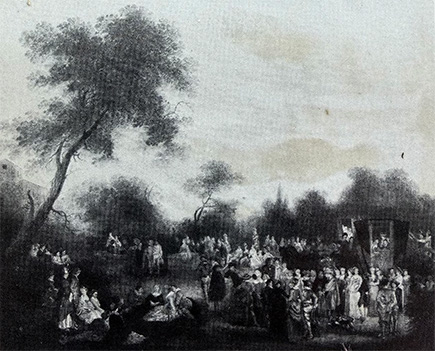
Whereabouts unknown
Materials unknown
Measurements unknown
PROVENANCE
New York, sale, PB 84, November 29, 1978, lot 124: “SCHOOL OF BONAVENTURE DE BAR. A FETE CHAMPÊTRE. 23 x 29¾ inches (58 x 75.5 cm.).” Bought for $800.
REMARKS
Although this painting was attributed to Jean François Schall (1752-1825) when it appeared at auction in 1978, it is only an anonymous copy after the Cochin engraving of La Mariée de village.
|
La Mariée de village (copy 8)
Entered February 2026
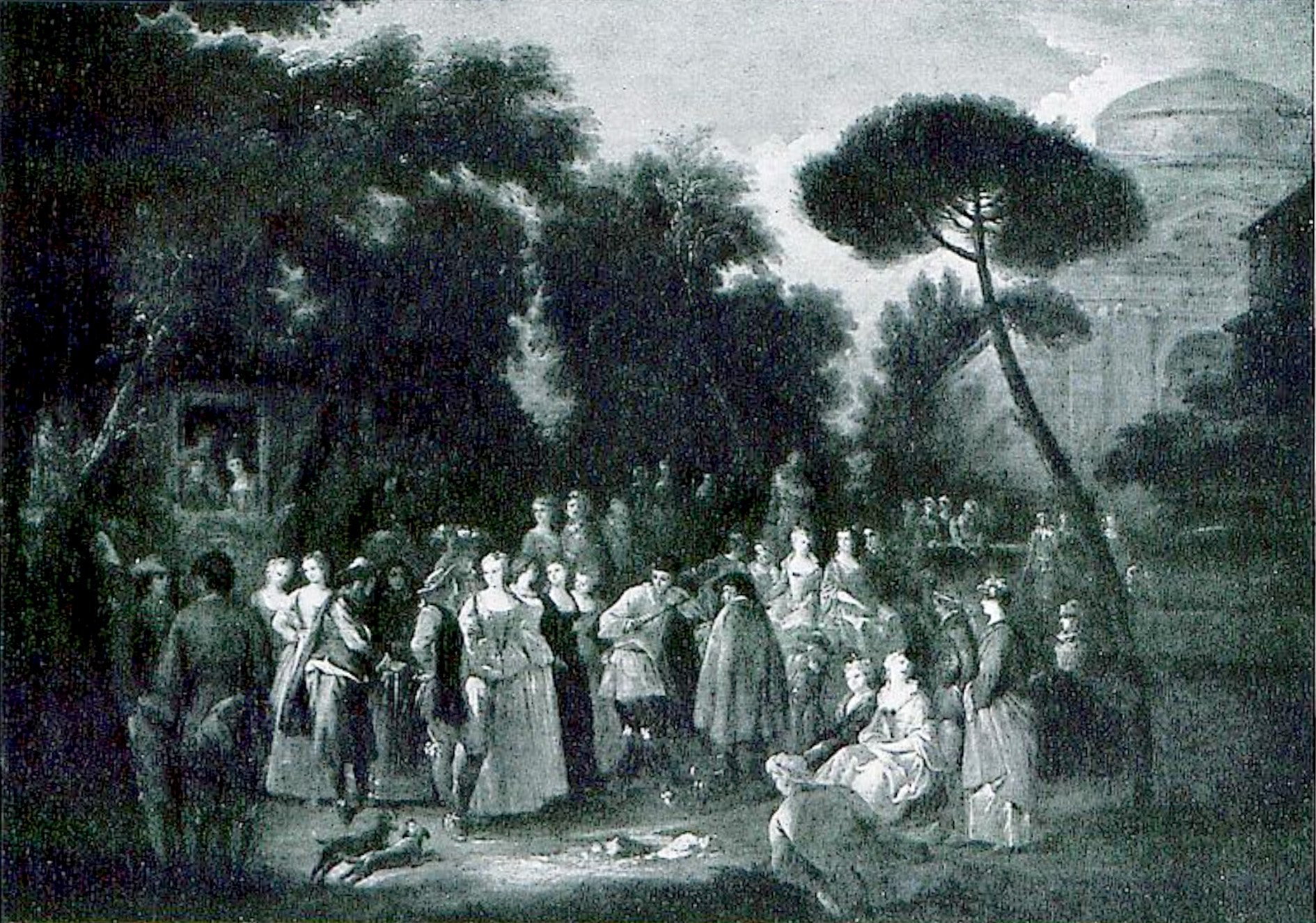
Whereabouts unknown
Oil on canvas
95 × 130 cm
ALTERNATIVE TITLES
Ein Gartenfest
PROVENANCE
Berlin, sale, Lepke, May 16, 1933, lot 299: “CLAUDE GILLOT. ZUGESCHRIEBEN. . . EIN GARTENFEST. Eine zahlreiche Gesellschaft von Herren und Damen im Park, dabei Musikanten. Links eine vergoldete Sänfte, rechts ein großer tempelartiger Bau. Lwd. Gr. 95 ×130 cm. Geschnitzter G.-R.”
REMARKS
The painting is a partial copy of La Mariée de village, executed by an anonymous artist. It is painted in the same direction as Watteau’s original canvas, which allows that it was copied from the original in Berlin. Its emergence in Germany reinforces the idea that it was copied from the Berlin painting. The attribution to Claude Gillot is basisless.
|
La Mariée de village (copy 9)
Entered February 2026; revised September 2026

Whereabouts unknown
Materials unknown
60.9 × 80 cm
PROVENANCE
Cheltenham, Battledown House, collection of Alexander Smith, his sale and others; London, Christie’s, November 26, 1928, lot 29: “WATTEAU. LA MARIÉE DE VILLAGE. 24 in. by 31 1/2.” Bought for 23.2 guineas by Stuart.
REMARKS
Almost nothing is known about this picture. Its large dimensions suggest it was on canvas. Perhaqps it is to be associated with the painting cataloged as copy 12.
|
La Mariée de village (copy 10)
Entered February 2026

Whereabouts unknown
Oil on panel
22 × 28 cm
PROVENANCE
Paris, collection of Mme X; her sale, Paris, Blond, December 13-14, 1943, lot 78: “WATTEAU (D'après Antoine). LA MARIEE DE VILLAGE. Bois. Haut., 0m22; Larg., 0m28.”
REMARKS
Nothing more is known about this picture.
|
La Mariée de village (copy 11)
Entered February 2026
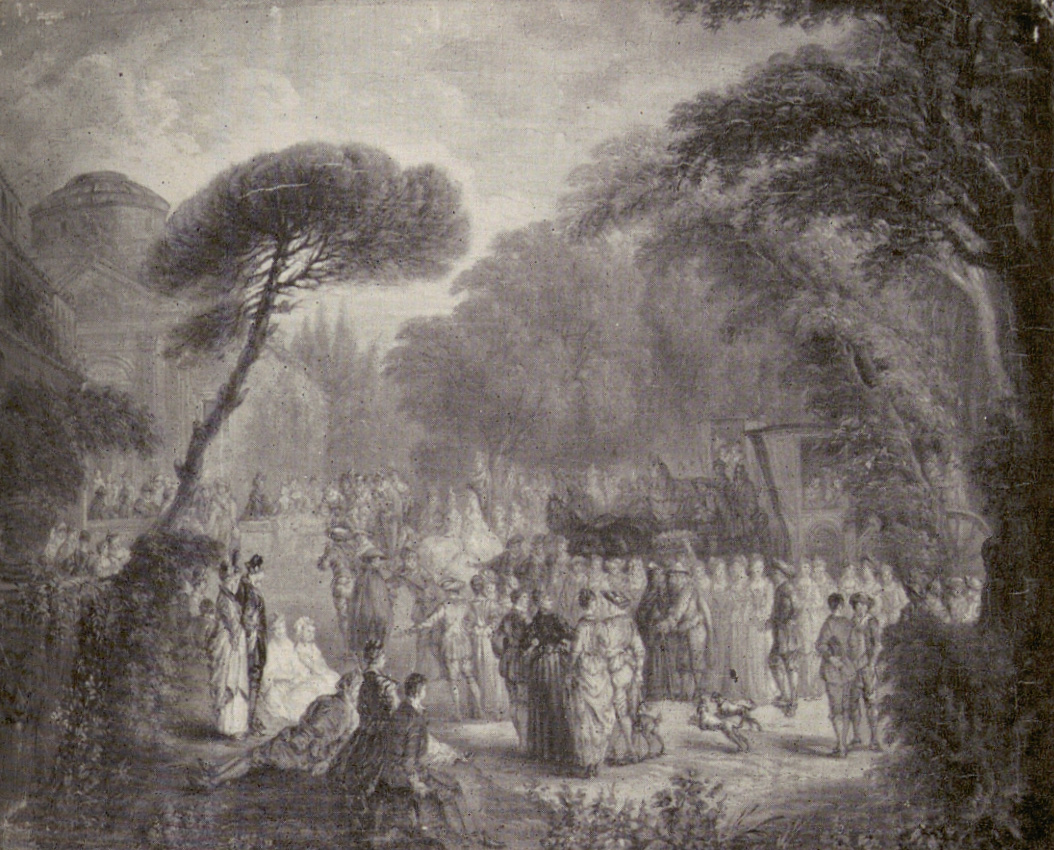
Whereabouts unknown
Oil on panel
26.5 × 35 cm
ALTERNATIVE TITLES
The Royal Promenade
PROVENANCE
England, collection of a "gentleman.” His sale, London, Sotheby’s, May 4, 1977, lot 127: “ALEXANDRE PAUL JOSEPH VERON. THE ROYAL PROMENADE. Signed, on panel 10 1/2 in. by 13 3/4 in. 26.5 cm. by 35 cm.”
REMARKS
The painting is a copy after the Cochin engraving of La Mariée de village. The signature indicates that it was executed by the nineteenth-century imitator of Watteau, Alexandre Véron (1826-1897).
|
La Mariée de village (copy 12)
Entered February 2026; revised September 2026
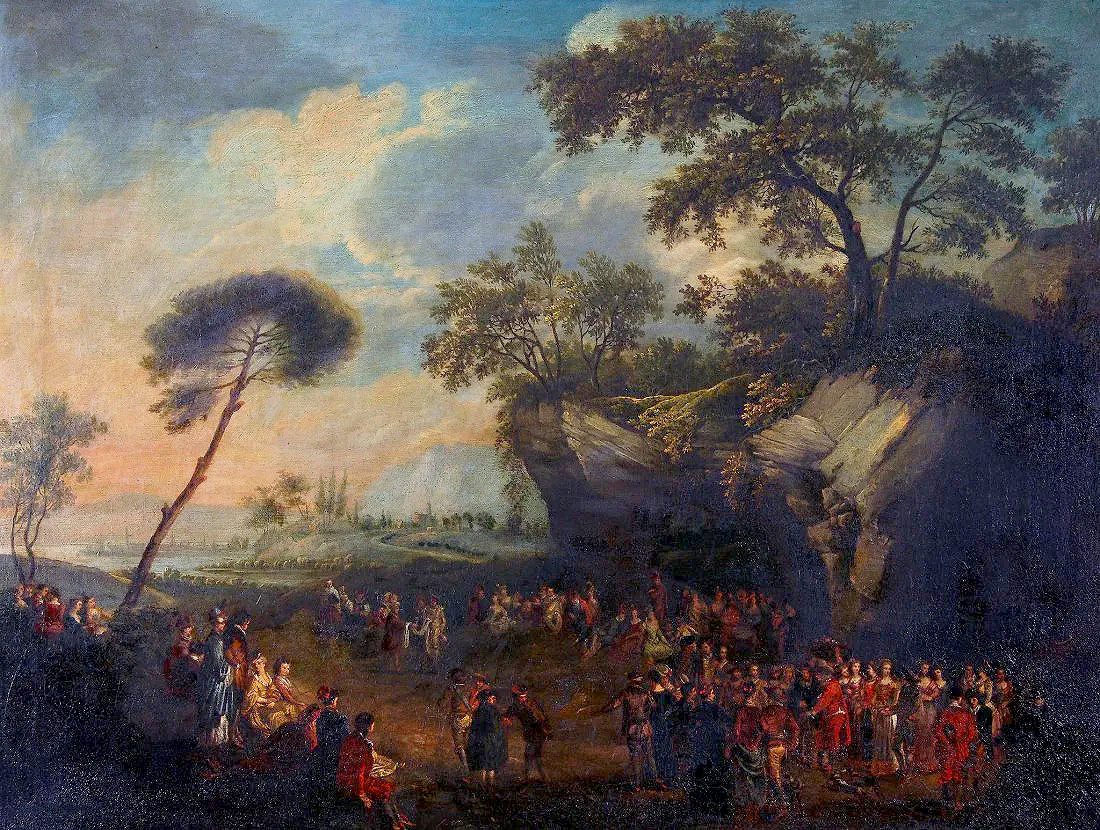
Whereabouts unknown
Oil on canvas
63.5 × 81 cm
ALTERNATIVE TITLES
A Village Fête
PROVENANCE
Bristol, Clifton Wood House, collection of Margaret Haig Ma, 2nd Viscountess Rhondda Dowager Lady Mackworth (1883-1958).
Newbury, Dreweatts Donnington Priory, sale, June 4, 2014, lot 24, and August 28, 2014, lot 325: “Follower of Jean Antoine Watteau - A village fete. Oil on canvas 63.5 x 81 cm (25 x 32 in) Provenance: The collection of the Dowager Lady Mackworth, Clifton Wood House, Bristol; from who purchased by the present owner’s father, circa 1947. The present painting is after a lost original.”
REMARKS
Perhaps this is the unsually large copy catalogued here as Copy 9. The painter responsible for this picture had a distinctive approach. Although he faithfully copied the many figures from La Mariée de village, he did not retain them as a whole configuration. Rather, he separated them into small clusters that he then distributed into a vast landscape of his own devising. The result is a picture that is more a landscape than the Watteaus‘ figurative composition. A similar approach can be seen in another of his variants after La Mariée de village—our copy 14. These and similar variations after Watteau have an English provenance, and may indicate the copyist’s nationality.
|
La Mariée de village (copy 13)
Entered February 2026
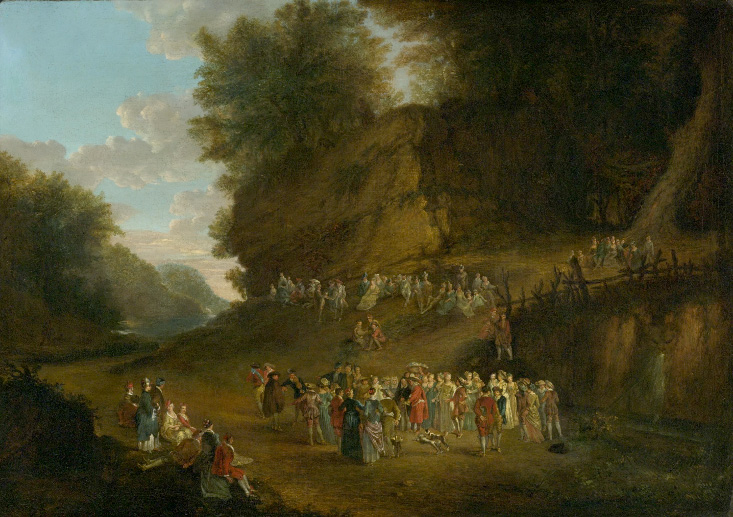
Whereabouts unknown
Oil on canvas
72.4 × 97.5cm
PROVENANCE
Sale, London, Christie’s, December 18, 1980, lot 20: “François Louis Joseph Watteau, called Watteau de Lille. A festival in a rocky wooded landscape signed 27 1/4 × 38 in. (69.2 × 96.5 cm.)”
Sale, New York, Sotheby’s, June 5, 2014, lot 87: "Circle of Antoine Watteau. Rustic festival in a rocky wooded landscape. Signed lower left: Watteau. Oil on canvas. 28 1/2 × 38 3/8 inches.
Provenance: Anonymous sale, London, Christie's, 18 December 1980, lot 20 (as by Watteau de Lille); There purchased by the present owner. The foreground figural group in this painting is taken from Watteau's Le [sic] Mariée de village (Château de Sans-Souci, Potsdam). The arrangement of the group in the present composition, however, follows that of Charles-Nicolas Cochin's engraving from 1729 (an example of which is the National Gallery of Art, Washington, inv. 1942.9.2092).”
REMARKS
Like the previous painting, which similarly has an English provenance, this picture’s figurative component is wholly dependent on Watteau’s La Mariée de village. But, at the same time, these figures have been transposed into a landscape of a very different sort. It does not appears to be French or eighteenth century. It could well be English and nineteenth century.
|
La Mariée de village (copy 14)
Entered February 2026
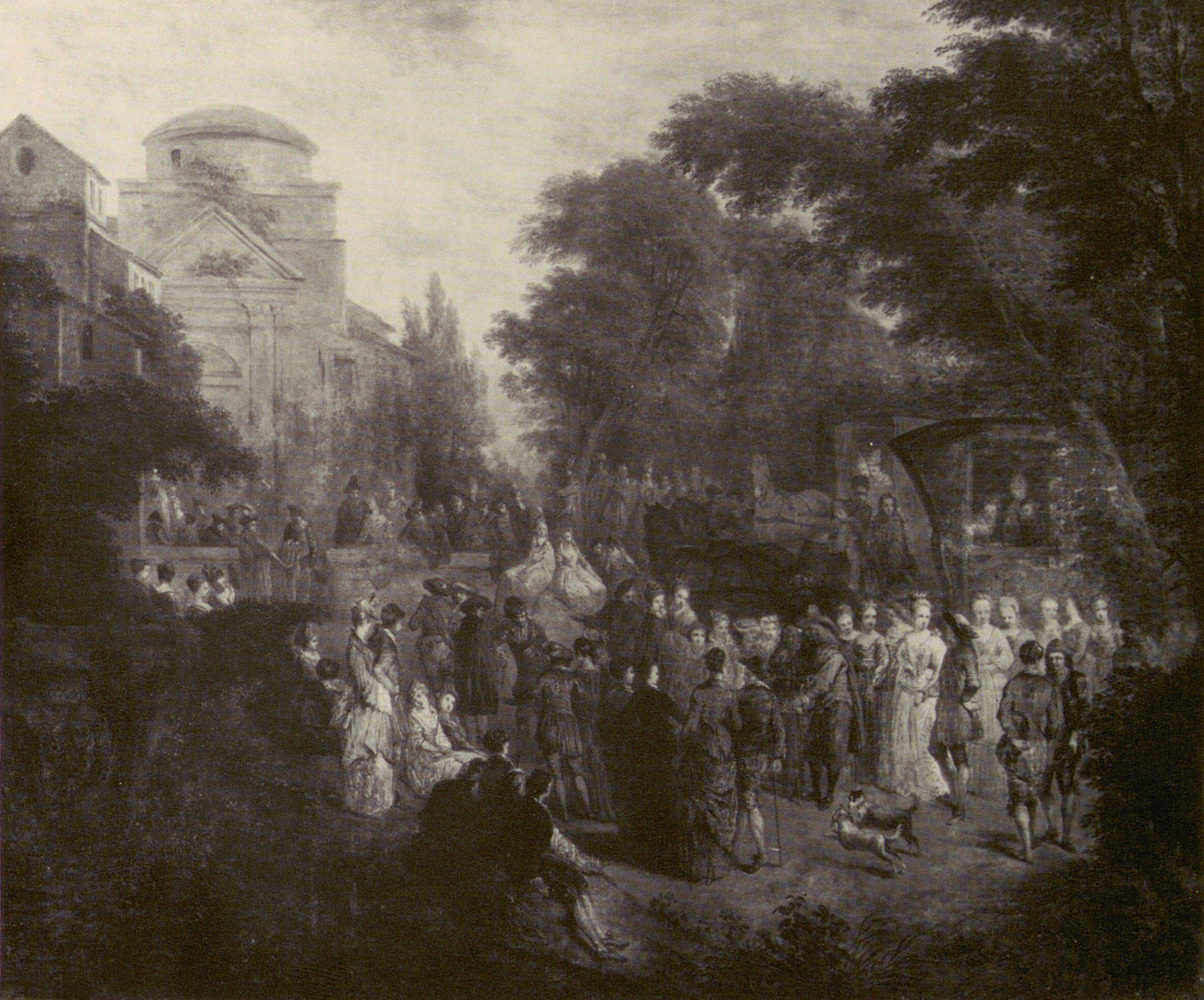
Whereabouts unknown
Oil on canvas
74 × 90 cm
PROVENANCE
Sale, Paris, Ader, Picard, Tajan, April 25, 1989, lot 89: “École Française du milieu du XVIIIe siècle. Scène galante avec architecture et une calèche arrivant dans un parc. Toile. 74 × 90 cm. Sans cadre. Voir la reproduction en couleurs sur la couverture.”
REMARKS
As can be told by its reversal of Watteau’s composition, this picture corresponds to the engraving by Charles Nicolas Cochin. The attribution to the mid-eighteenth century is perhaps too generous.
|
La Mariée de village (copy 15)
Entered February 2026
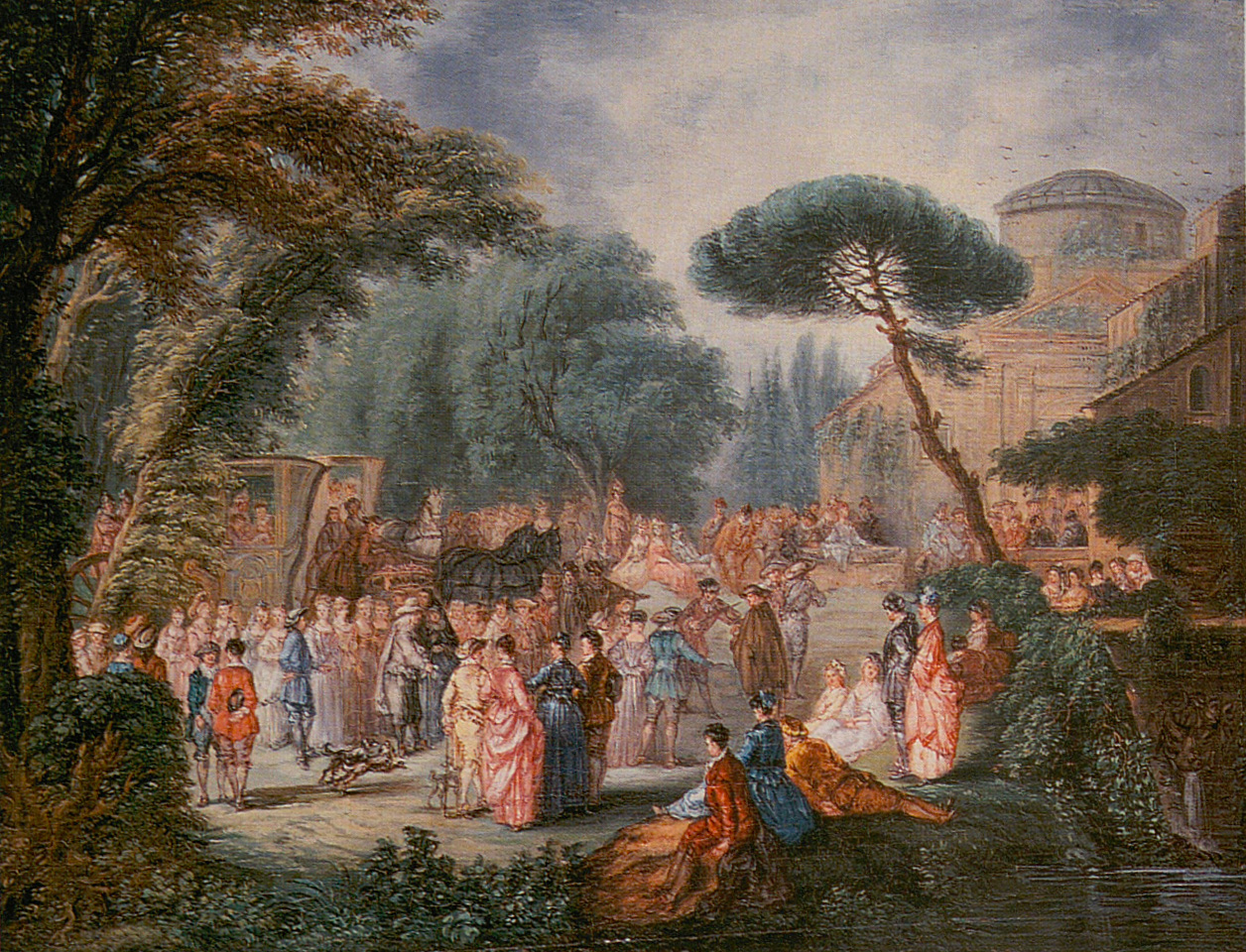
Whereabouts unknown
Oil on panel
26.7 [or 25.5] × 34.9 cm
ALTERNATIVE TITLES
L'Arrivée du carrosse
An Elegant Company Out-of-doors with the Arrival of the Bridal Couple
PROVENANCE
Paris, sale, Couturier, Nicolay, March 7, 1984, lot 60: “VERON Alexandre-René - 1826-1897.. . Deux pendants : FÊTE GALANTE DANS UN PARC. L’ARRIVÉE DU CARROSSE. Panneaux. Haut. : 0,255 m × 0,35 m. Voir la reproduction de l'un d'eux en page de couverture."
Sale, London, Christie’s, April 3, 1992, lot 46: “Manner of Jean Antoine Watteau / An elegant Company out-of-doors with a marriage contract discussed; and An elegant Company out-of-doors with the arrival of the Bridal couple on panel / l
10 ½ x 13 ¾ in. (26.7 × 34.9cm.) a pair (2) / £6,000-8,000.”
SELECT BIBLIOGRAPHY
Eidelberg, “Defining the Oeuvre of Bonaventure de Bar” (Part 2), cat. X3.
REMARKS
The difference between the listing of this painting and its pendant in 1984 and 1992 is instructive. It was first given to the known nineteenth-century copyist of Watteau, Alexandre Véron (1826-1897). One might have thought that there had been some justification for this, yet just a few years later that line of thought was abandoned, and it was classified with the generic ascription ‘’manner of Watteau.’’
On these occasions, the pendant was not named specifically, but in 1992 it was illustrated. It proves to be a copy of La signature du contrat de la noce de village, a picture often claimed to be by Watteau but which is a variant composition by Bonaventure de Bar.
|
La Mariée de village (copy 16)
Entered February 2026
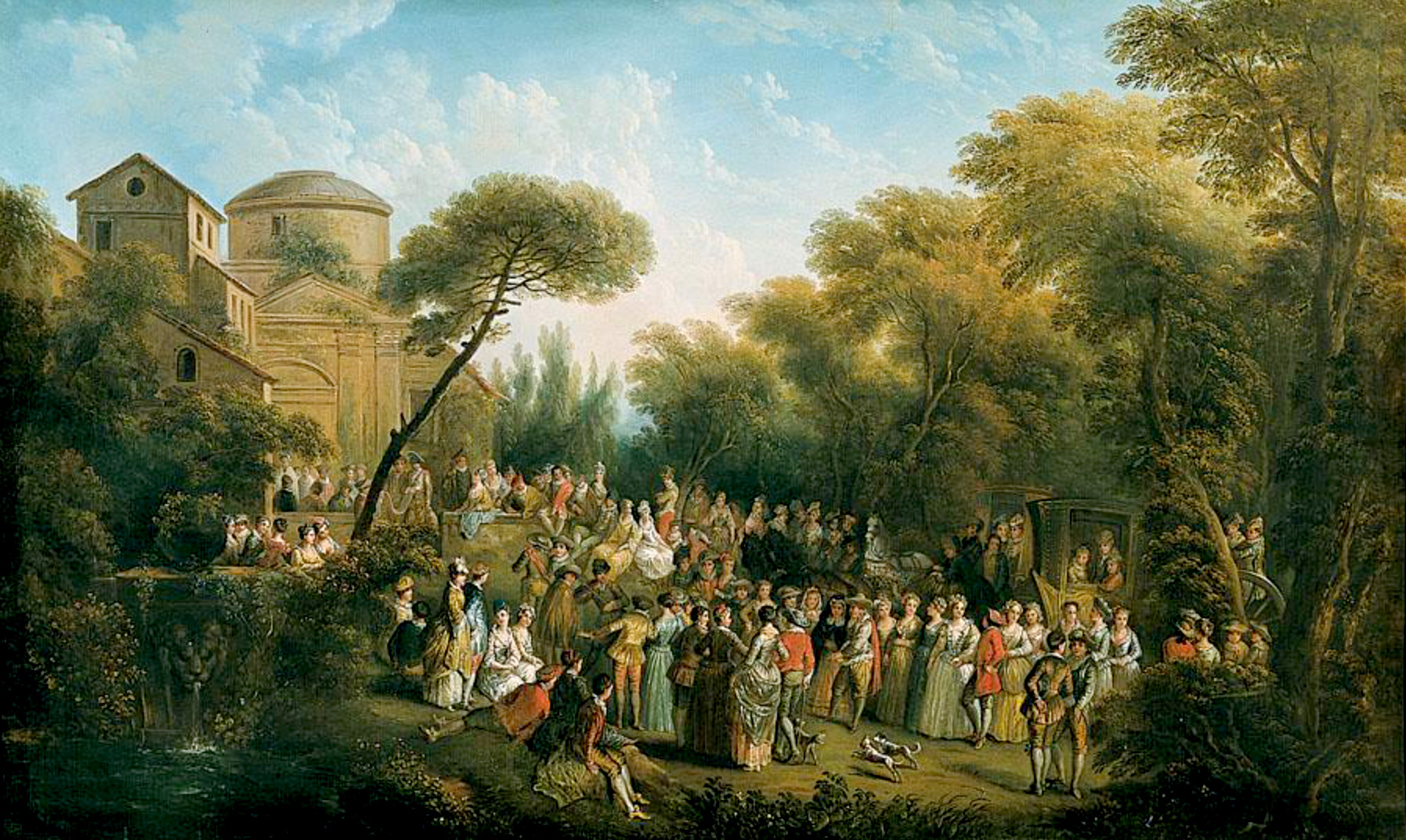
Whereabouts unknown
Oil on canvas
70 × 115 cm
ALTERNATIVE TITLES
Cerimonia nuziale all’aperto
PROVENANCE
Milan, sale, Sotheby’s, June 1, 2004, lot 98: “DA JEAN ANTOINE WATTEAU. CERIMONIA NUZIALE ALL’APERTO. Olio su tela. 70 × 115 cm. Il dipinto è una copia antica a reverse di una composizione di Watteau conservata a Berlino, Castello di Charlottenburg (vedi E.C. Montagni, L'opera completa di Watteau, Milano 1968, pag. 99, n. 63, ill).”
REMARKS
As this picture is in the opposite direction of Watteau’s canvas in Berlin, it can be presumed to have been copied after the print by Charles Nicolas Cochin.
|
La Mariée de village (copy 17)
Entered February 2026
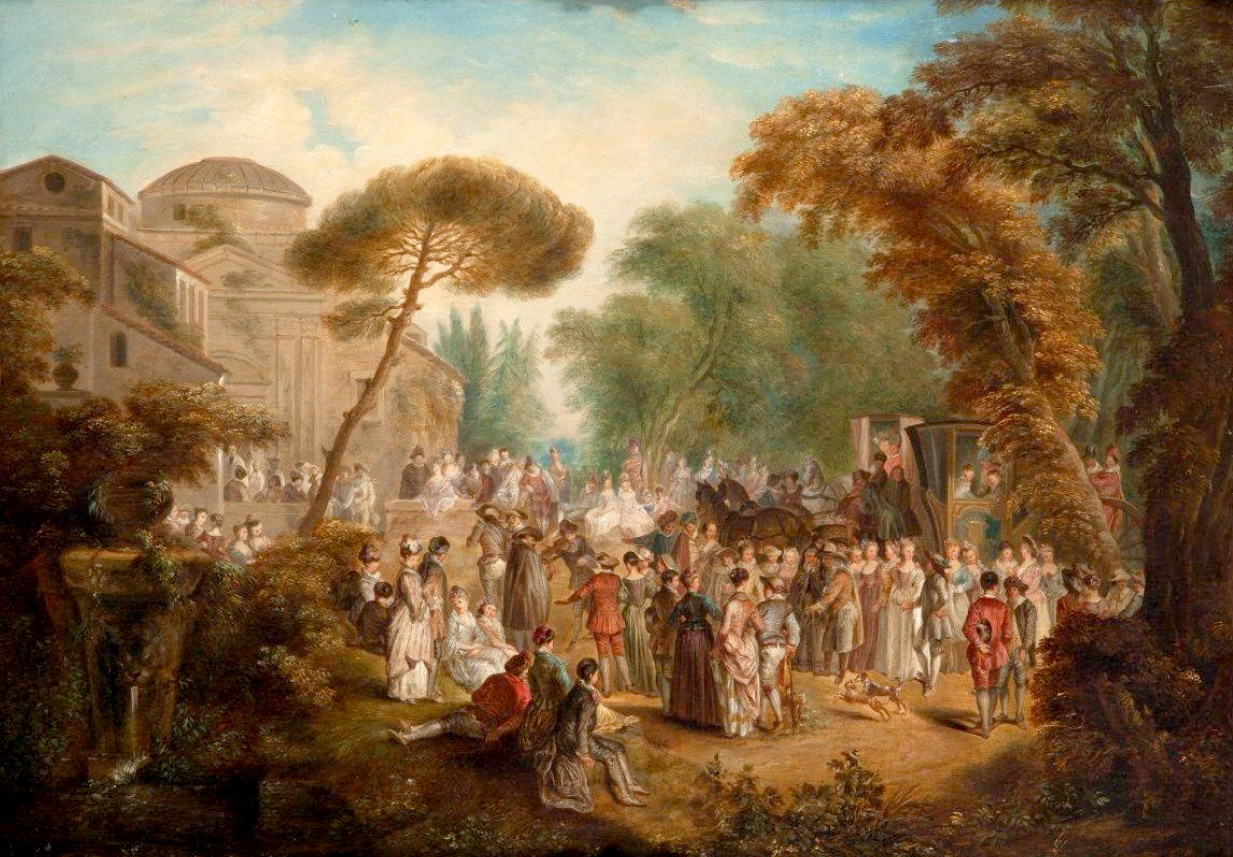
Whereabouts unknown
Oil on canvas
52 × 73 cm
ALTERNATIVE TITLES
Le Cortège de la mariée
PROVENANCE
Sale, Paris, Gros & Delettrez, December 21, 2012, lot 45: "After Jean Antoine Watteau. L’accordée de village et le Cortège de la mariée / (pair) / Ecole Française du XIXème siècle. Painting on canvas. Autour de 1800-1899. Hauteur 20,5 in.; Largeur 28,7 in. / Hauteur 52 cm.; Largeur 73 cm. Est.€5-7,000 the pair. ($6,583-$9,216 the pair)." Sold for €12,200 the pair ($15,799 the pair).
REMARKS
This picture and its pendant, a copy after L’Accordée de village, are by admission nineteenth-century copies, made after the respective prints in the Jullienne Oeuvre gravé.
|
La Mariée de village (copy 18)
Entered February 2026

Whereabouts unknown
Material unknown
Measurements unknown
PROVENANCE
France, collection of Auguste Stevens; his sale, Paris, Bonnefons, March 1, 1847, lot 318: “WATTEAU (Antoine). La Mariée de village, pendant du précédent. Au milieu d'une nombreuse société, le jeune couple, précédé des parents et d'une troupe de musiciens, se dirige vers un temple; le cortège est suivi par une foule de curieux de toutes conditions qui se trouvent sur le passage. Il serait fort long d'énumérer toutes les figures de ces deux importantes compositions, et encore plus de décrire les actions de chacun; nous nous bornerons à dire qu'ils offrent une image fidèle des fêtes villageoises que l'on représentait sur le théâtre à cette époque. Deux ouvrages en tapisserie, des mêmes sujets et grandeur, existent dans la collection du duc de Devonshire, en Angleterre, raison pour laquelle Watteau les a peints de cette grandeur extraordinaire.” Bought respectively for 800 and 620 francs by Didsbury.
BIBLIOGRAPHY
Réau, “Watteau” (1928), under cat. 89.
REMARKS
This reportedly large canvas was indicated in an annotated copy of the 1847 as a copy and was sold with a pendant, a copy of L’Accordée de village. The two were supposedly used as cartoons for tapestries then owned by the Duke of Devonshire. However, there is no confirmation of this from Chatsworth.
|
La Mariée de village (copy 19)
Entered February 2026
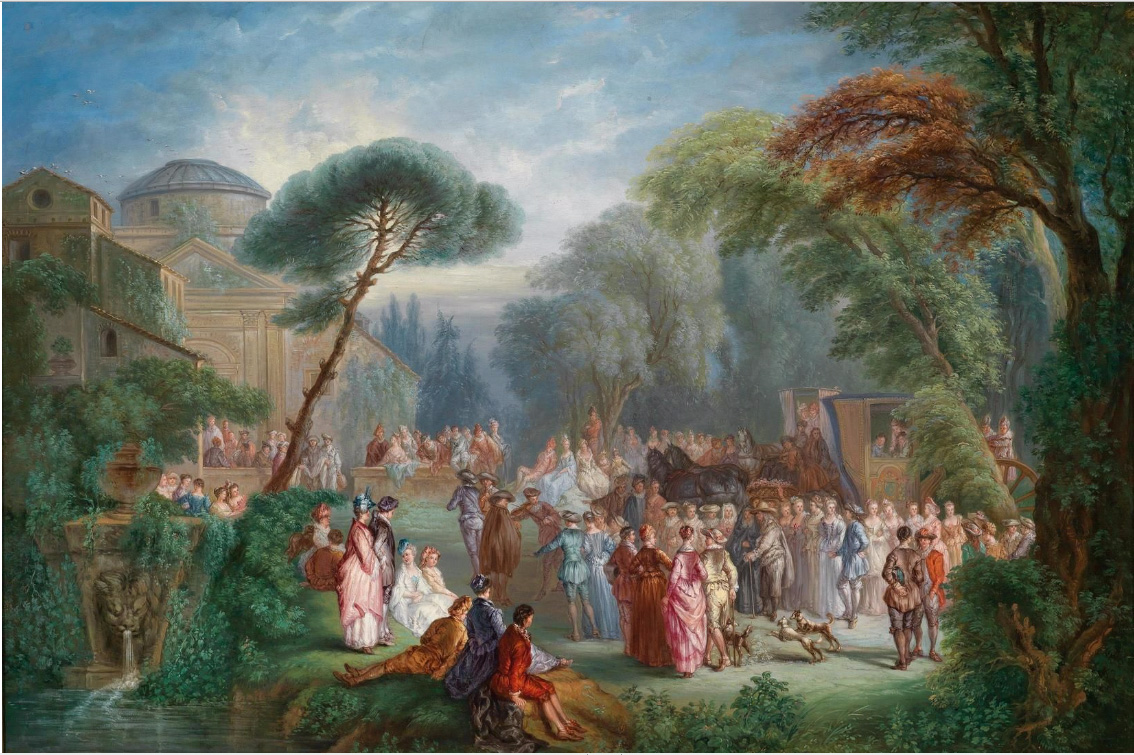
Whereabouts unknown
Oil on panel
55 × 79 cm
PROVENANCE
Münster, Germany, collection of Rinckklage van Endert, 1970s.
Germany or Austria (?), private collector. His sale, Vienna, Dorotheum, October 21, 2014 lot 388: “Circle of Louis Joseph Watteau - a pair (2). (Valenciennes 1731–1798 Lille). La signature du contrat de la noce de village; and La mariée de village, inscribed lower left and lower right: Watteau, oil on panel, each 55 × 79 cm, framed (2). On the reverse a red wax seal. Provenance: Rinckklage van Endert, Münster, 1970s; Acquired there by its current owner. The present pair imitates engravings based on Antoine Watteau’s paintings, one of which, ‘The Village Bride’, is preserved in Schloss Charlottenburg, Berlin.”
Vienna, sale, Dorotheum, December 10, 2015, lot 169: “Follower of Louis Joseph Watteau-a pair (2). La Signature du contrat de la noce de village; and La Mariée de village, inscribed at lower left and right respectively: Vatteau, oil on panel, each 55 x 79 cm, framed (2). Red wax seals on the reverse. Provenance: Rinckklage van Endert, Münster, 1970s; whence acquired by the present owner. The present pair repeats engravings based on paintings by Antoine Watteau; Village Wedding is preserved in Charlottenburg Palace, Berlin.
Vienna, sale, Dorotheum, December 19, 2016, lot 245: “Follower of Louis Joseph Watteau – a pair (2). La Signature du contrat de la noce de village; La Mariée de village, inscribed lower left and right respectively: Vatteau, oil on panel, each 55 x 79 cm, framed (2). A red lacquer seal on the reverse. Provenance: Rinckklage van Endert, Münster, 1970s; whence acquired by the present owner. The present pair copies engravings based on paintings by Antoine Watteau. The Village Wedding is preserved at Charlottenburg Palace, Berlin.”
REMARKS
Despite the attempt to attribute this painting and its pendant to Louis Joseph Watteau de Lille (1731-1798), they are anonymous, probably nineteenth-century copies. The pendant was a copy of La signature du contrat de la noce de village, a composition thought to be by Watteau and often paired with La Mariée de village. This second composition, attributable to Bonaventure de Bar), is a variation on Watteau’s Mariée de village.
|
La Mariée de village (copy 20)
Entered February 2026
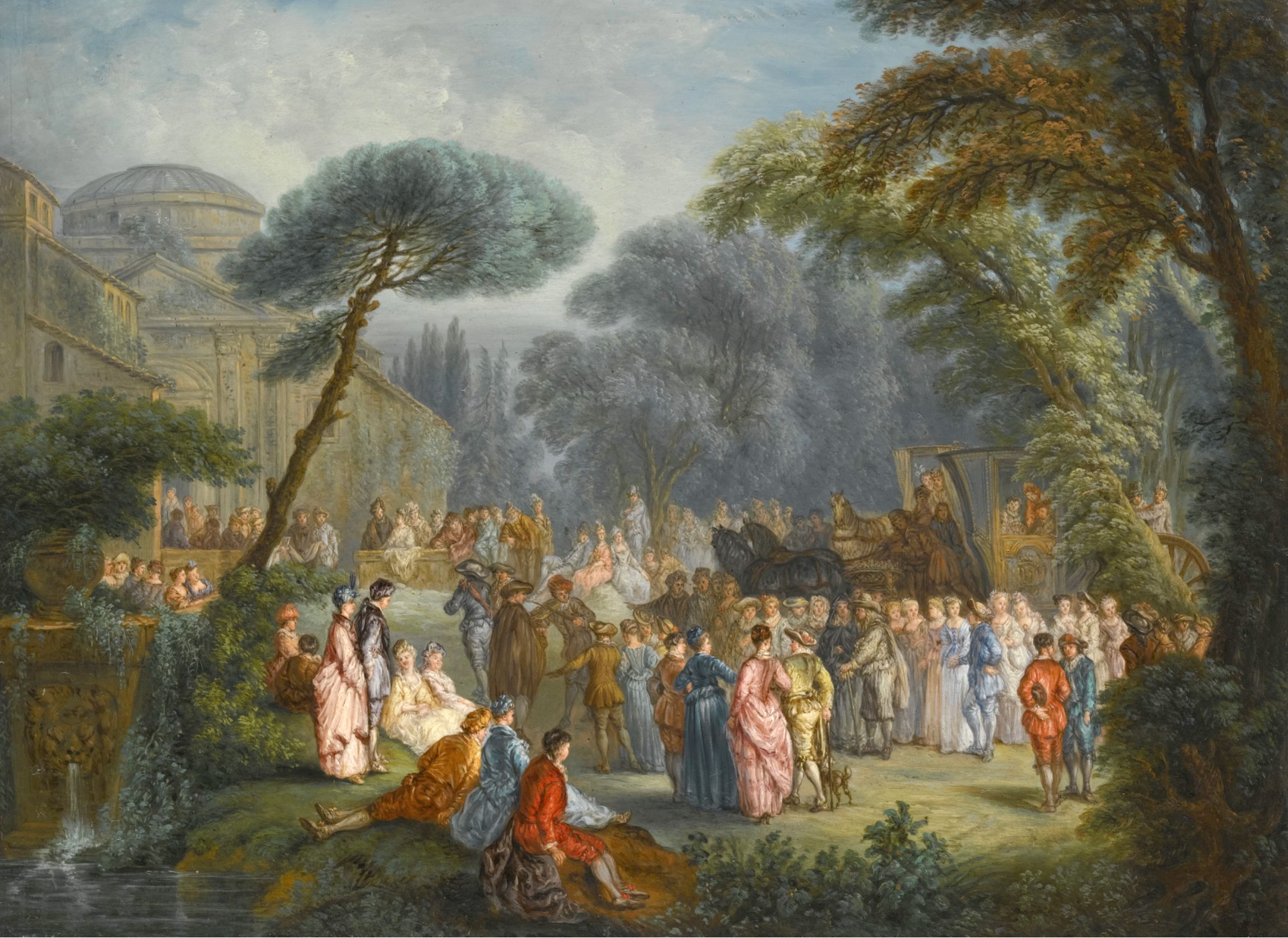
Whereabouts unknown
Oil on panel
25 × 35 cm
ALTERNATE TITLES
An Elegant Party in a Park
PROVENANCE
London, sale, Sotheby’s, April 29, 2015, lot 593: “Vernon, Alexandre Paul Joseph. AN ELEGANT PARTY IN A PARK. Oil on panel. 25 by 35 cm.; 9 3/4 by 13 3/4 in.”
REMARKS
The painting has been ascribed to the well-known copyist of Watteau, Alexandre Véron (1826-1897). This attribution may be accurate, but the painting is not signed or otherwise documented. Its left-right orientation shows that the artist was working from Charles Nicolas Cochin‘s engraving after La Mariée de village .
|
La Mariée de village (copy 21)
Entered February 2026; revised September 2026
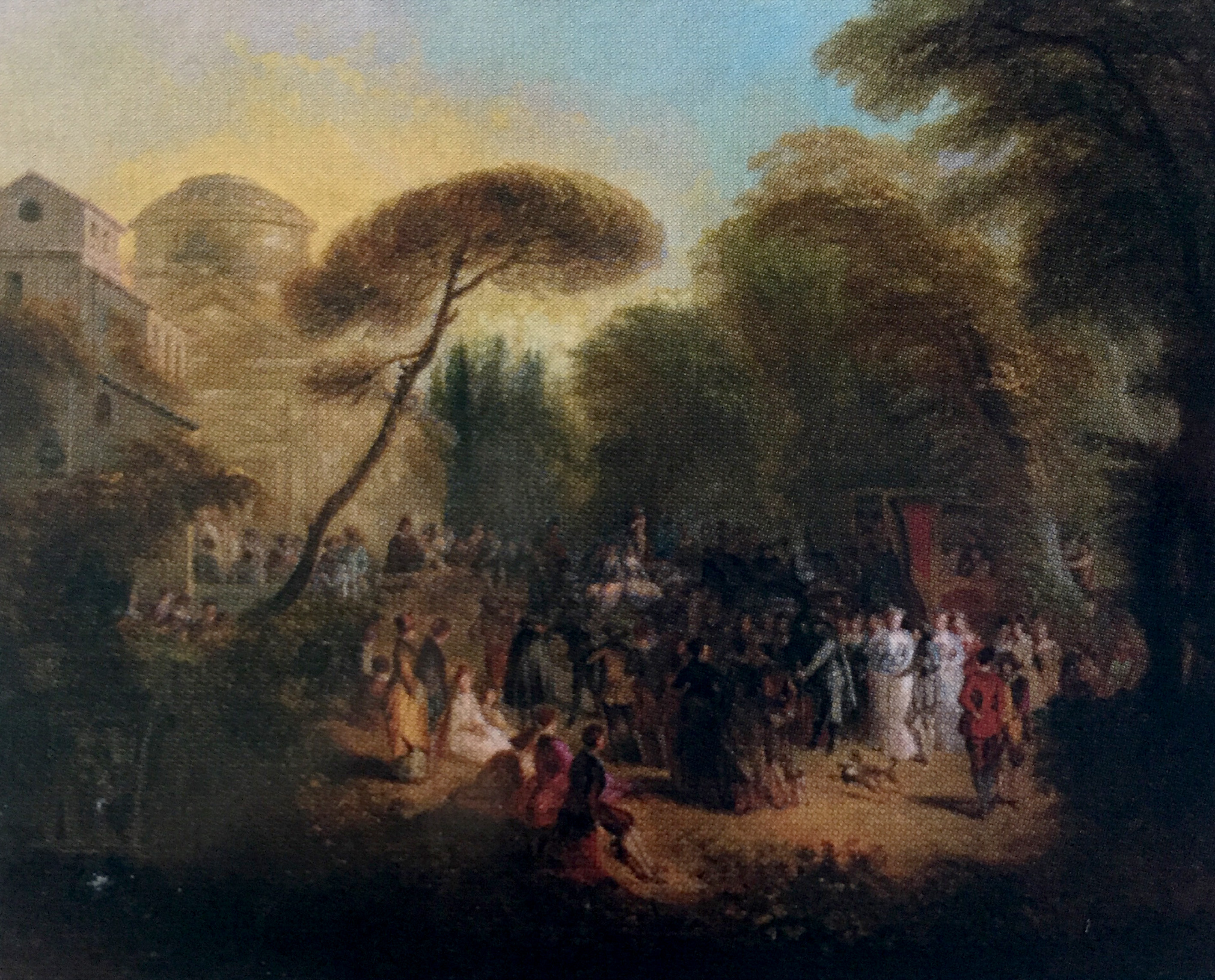
Whereabouts unknown
Oil on canvas
94 x 94 cm
ALTERNATIVE TITLES
Scène galante
PROVENANCE
Geneva, sale, Galerie Koller, November 17-18, 2002, lot 1289: “ÉCOLE FRANÇAISE, 18e s. Scène galante. Huile sur toile. 94 × 74 cm. CHF 5 000.– / 7 000.- /(€ 3 400.- / 4 760.-) / Voir ill.“
REMARKS
The left-right orientation of the picture shows that the copyist was working from Charles Nicolas Cochin‘s engraving after La Mariée de village. The figures are unusually distinctive but, for the moment cannot be linked to other paintings by this artist.
|
La Mariée de village (copy 22)
Entered February 2026
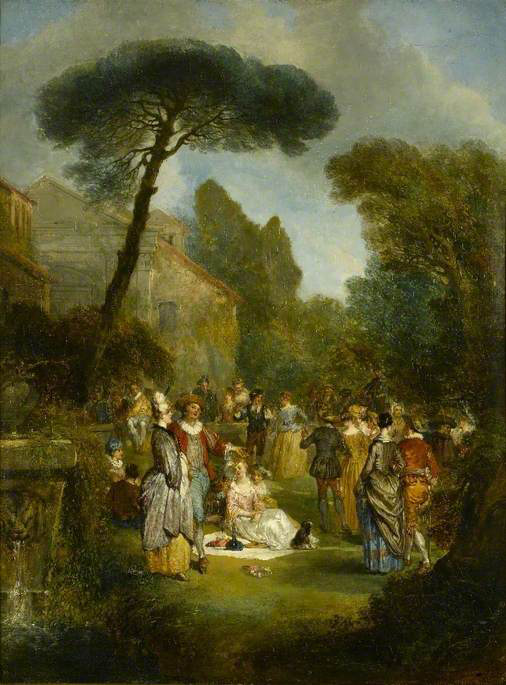
Aylesbury, Chequers Court
Oil on canvas
61 × 44.5 cm
ALTERNATIVE TITLES
A Fête
SELECT BIBLIOGRAPHY
Watteau, , X. L‘Escarpolette.
REMARKS
This picture, like many other such paintings after Watteau, was executed by the nineteenth-century Watteau imitator, Henry Andrews (1816-1898). Essentially, it copies a portion of the master’s Mariée de village but omits some of that painting‘s chief elements including the bridal procession, the wedding carriages, the great domed church, and many of the subsidiary figures. Moreover, by adjusting the scale of the figures in relation to the landscape, Andrews created a faux fête galante that is at a remove from Watteau’s operatic rendition. It resembles more a nineteenth-century scene of costumed urbanites in a contemporary park.
|
La Mariée de village (copy 23)
Entered February 2026
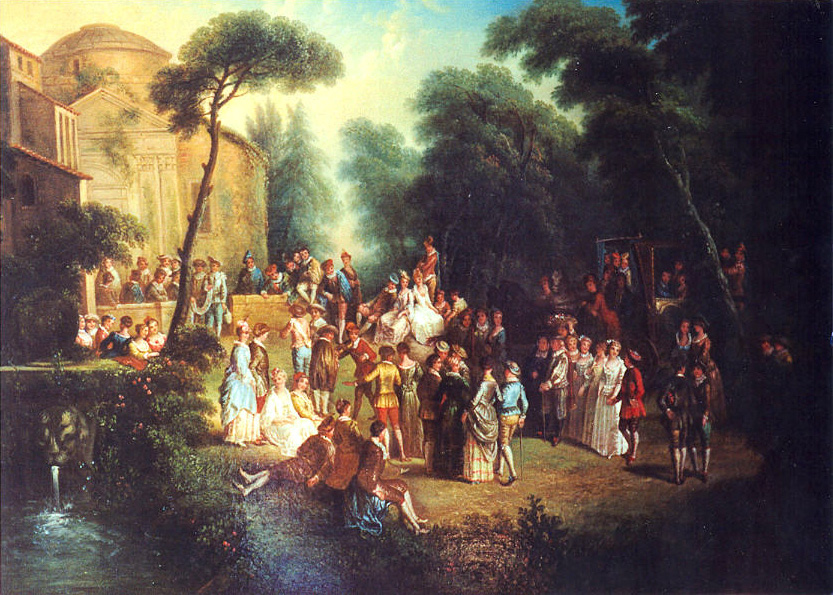
Whereabouts unknown
Oil on canvas
67.5 × 92.5 cm
PROVENANCE
Blois (?), collection of the father of Marcel Castillon.
Blois, collection of Marcel Castillon (1935-2023); sold on EBay, July 21, 2017: “Cette superbe huile sur toile, avec bel encadrement doré fait sur mesure, est un bien familial depuis 150 ans . . . d’origine faisait partie d’une paire, le premier s’intitulant 'L’accordée de village.' Dim: 1m x 0,75 cadre inclus. Elle date probablement aussi du début du XIXe Siècle.”
REMARKS
The left-right orientation of the picture shows that the copyist was working from Charles Nicolas Cochin‘s engraving after La Mariée de village.
|
La Mariée de village (copy 24)
Entered February 2026
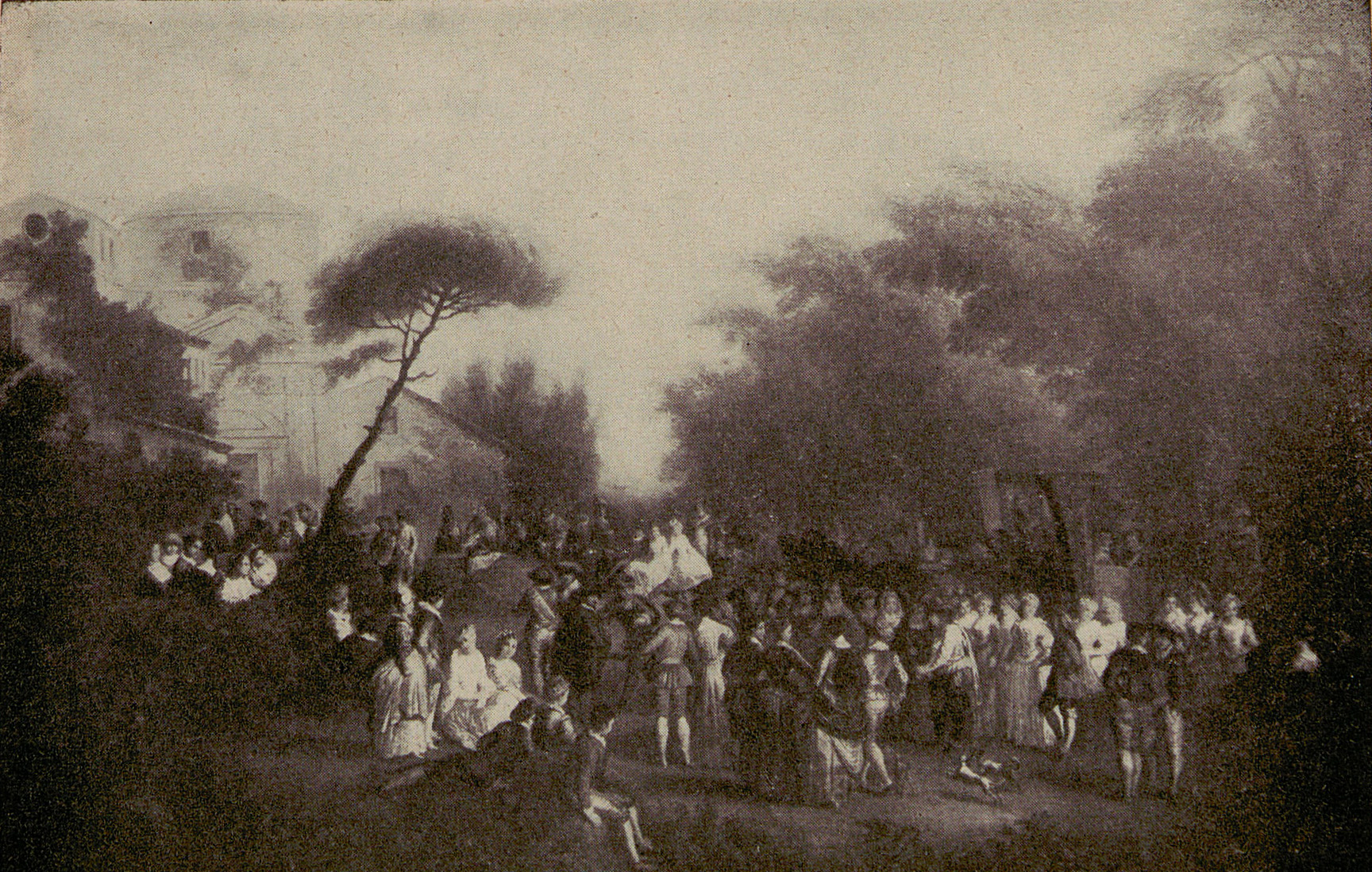
Whereabouts unknown
Oil on canvas
130 × 195 cm
PROVENANCE
Tours, collection of Étienne Monnier (banker), c. 1959.
Le Pecq, Yvelines, private collection in 1977.
EXHIBITIONS
Tours, Musée des beaux-arts, L’Art ancien (1959), cat. 40 (as attributed to Bonaventure de Bar, lent by Étienne Monnier).
Paris, Musée de la monnaie, Pèlerinage (1977), cat. 187 (as Ecole française du XVIIIe siècle, lent by a private collector).
SELECT BIBLIOGRAPHY
Paris, Musée de la monnaie, Pèlerinage (1977), cat. 187.
REMARKS
The left-right orientation of the picture shows that the copyist was working from Charles Nicolas Cochin‘s engraving after La Mariée de village.
|
La Mariée de village (copy 25)
Entered February 2026
Whereabouts unknown
Material unknown
Dimensions unknown
PROVENANCE
Paris, collection of M. Bordes, rue Henri de Bornier, according to a label attached to a photograph in the Service de documentation, Louvre, Département de peintures.
REMARKS
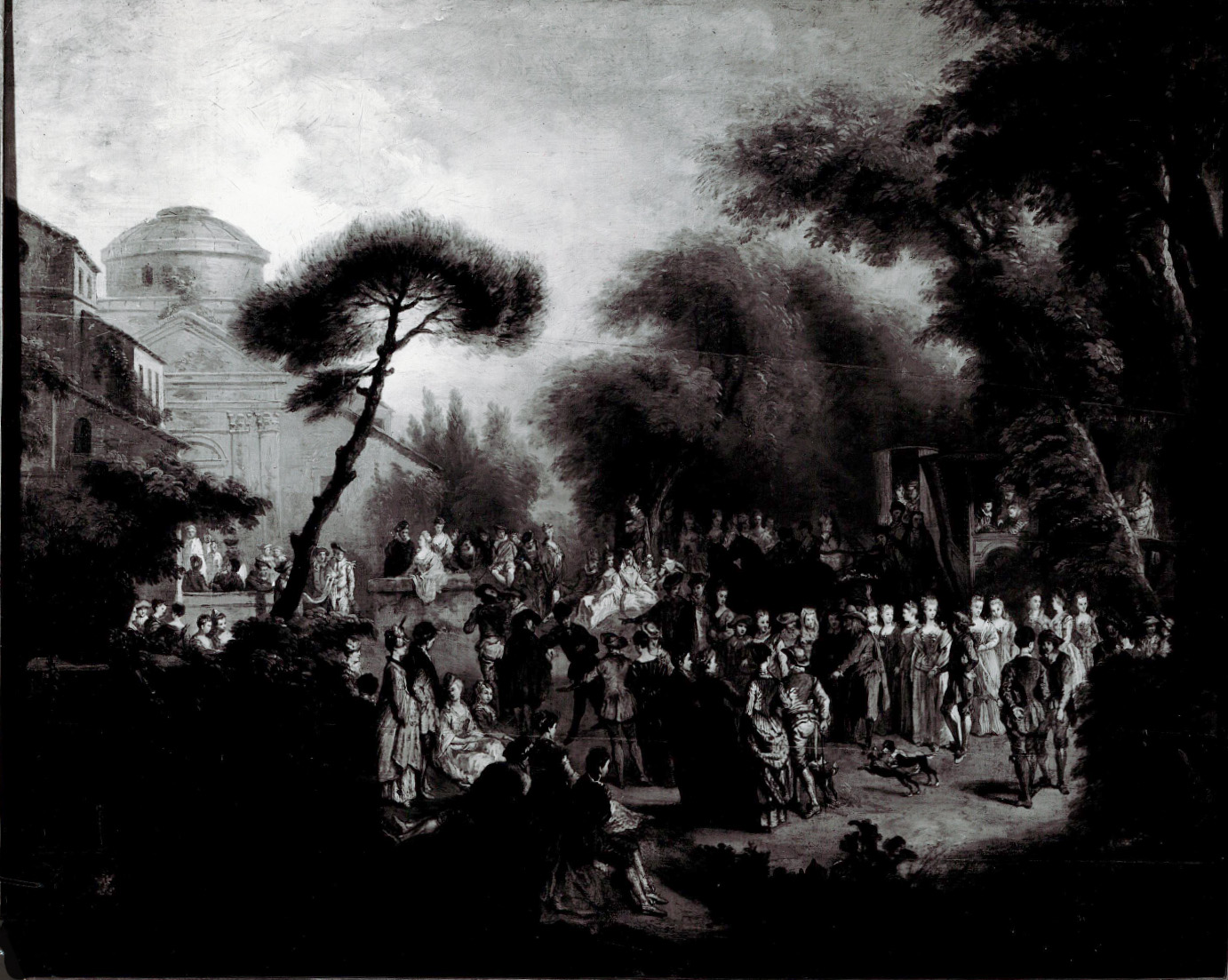
Except for its prior location, we know very little about this work. A photograph of it shows that it was executed in the opposite direction of Watteau’s canvas, and therefore must have ben based on the print by Charles Nicolas Cochin.
|
La Mariée de village (copy 26)
Entered February 2026
Whereabouts unknown
Material unknown
Measurements unknown
PROVENANCE
London, collection of Thomas Emerson; his sale, London, Phillips, June 15, 1832, lot 99: “WATTEAU . . . The original STUDY for his celebrated picture called ‘LA MARIEE DE VILLAGE’, engraved; nearly equal in colour to TITIAN.” Sold to Norton for £25.4.
REMARKS
Given the description of this painting as a "study," one might wonder as to its degree of its resolution.
|
Click here for La Mariée de village